Overview
The temple of Sri Ranganatha on the Kaveri at Srirangam, foremost of the 108 Divya Desams, where Sri Chaitanya Mahaprabhu spent Chaturmasya.
History & significance
The story of Srirangam
The Tamil Nadu HR&CE Department describes Srirangam as the foremost of the 108 Vaishnava Divya Desams, praised in hymns by ten of the Alwars. Lord Ranganatha reclines here, facing south. According to the temple's account, the sacred vimana was worshipped by Ikshvaku and his line in Ayodhya, and Lord Rama gave it to Vibhishana. As Vibhishana carried it towards Lanka he set it down on the bank of the Kaveri and could not lift it again; the Lord declared that He wished to stay there, facing south towards Lanka.
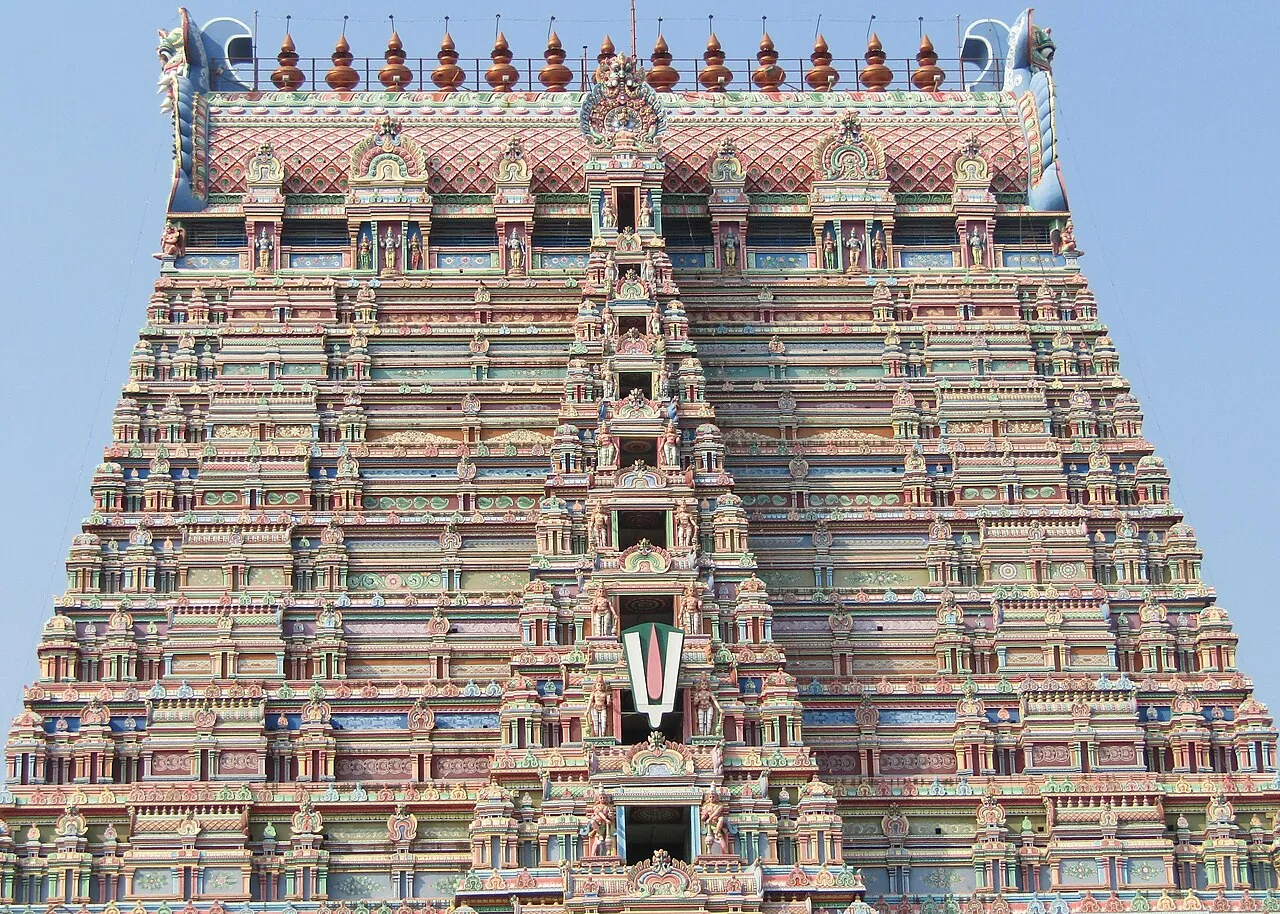
The sanctum is surrounded by seven enclosures (prakarams). The administrative system established by Sri Ramanujacharya is still followed in the temple. Work on the south Rajagopuram began in the Vijayanagara period but was left unfinished; it resumed in 1979 and the tower, 236 feet tall with 13 tiers, was consecrated on 25 March 1987.
The Chaitanya Charitamrita describes how Sri Chaitanya Mahaprabhu, during His South India tour, stayed for the four months of Chaturmasya at the house of Venkata Bhatta at Sri Rangam, bathing in the Kaveri and chanting and dancing in the temple daily. Venkata Bhatta's son, Gopala Bhatta, who also served the Lord at that time, later became Gopala Bhatta Goswami.
Highlights
- Foremost of the 108 Divya Desams, called Bhuloka Vaikuntham
- The only temple sung by all ten Alwars
- Lord Ranganatha reclines facing south
- Seven enclosures on a 156-acre island between the Kaveri and Kollidam
- 21 gopurams, led by the 236-foot Rajagopuram
- 644 inscriptions, from the Chola king Aditya I onwards
- Sri Ramanuja's shrine and temple administration
- Sri Chaitanya Mahaprabhu stayed here for Chaturmasya
Srirangam
Seven prakarams and 21 gopurams
The HR&CE Department records that the temple stands on an island between the Kaveri and Kollidam rivers and covers about 156 acres. Seven rectangular enclosures surround the sanctum, and the department describes Srirangam as the only temple in India with seven prakarams. Temple tradition compares the seven walls to the seven upper worlds, from Bhuloka to Satyaloka.
The innermost enclosure has herbal paintings on its ceiling and is closed to the public; devotees enter the sanctum through the Gayatri Mandapam. The outermost enclosure, the Chitrai streets, is a living town with houses on both sides, and it shelters the temple chariots.
There are 21 gopurams, and the temple notes that all of them can be seen at once from the top of the Ranga Vilas Mandapam. The main entrance on the south is the Ranga Ranga Gopuram, 81 feet tall with seven tiers. The east gopuram is kept painted white; according to temple tradition this honours Vellaiyammal, a temple dancer who gave her life to stop an invading king. Over the sanctum rises the golden Pranavakara vimana, shaped like the syllable Om.
Srirangam
Inscriptions and history
According to the HR&CE Department, South Indian Inscriptions Volume 24, published by the Archaeological Survey of India, lists 644 inscriptions in the temple. They range from the time of the Chola king Aditya I (871–907 CE) to the Nayak period. One Tamil inscription of 1048 CE records decisions taken by the temple's governing assembly at Srirangam.
Temple tradition holds that after a great flood the vimana lay buried in forest until a Chola king, Kili Cholan, found it by following a parrot's song and named the place Thiruvarangam. In his purport to the Chaitanya Charitamrita, Srila Prabhupada notes that the Alwar Tirumangai built the fourth wall and Tondaradippodi Alwar built the third wall and a tulasi garden. He also records that during an invasion the Deity was taken away for safety and reinstalled in 1371 CE, an event noted in an inscription by Vedanta Desika on the eastern wall.
Srirangam
Alwars and Sri Ramanuja
The temple describes Srirangam as the only shrine glorified by all ten Alwars. Tondaradippodi Alwar, who sang the Tiruppalliyezhuchi, praised no Divya Desam other than Srirangam, and according to the temple Andal and Tiruppan Alwar attained the Lord's feet here.
Sri Ramanuja, born at Sriperumbudur in 1017 CE, framed the temple's administration and reformed its worship according to the Parameswara Samhita of the Pancharatra Agama. The temple notes that he also appointed people from communities other than Brahmins to temple services. His shrine, the Udaiyavar Sannidhi, stands in the fifth enclosure. Devotees believe the form worshipped there is his own body; it receives no water abhishekam, and instead a paste of saffron, edible camphor and sandal is applied twice a year, in Chithirai and Aippasi.
Srirangam
Daily worship and sevas
Worship follows the Pancharatra Agama in the Tenkalai tradition. A special feature listed by the temple is the morning Viswaroopa Seva, performed in the presence of a cow, a horse and an elephant. Everything here is called periya, great: the Lord is Periya Perumal, the Mother is Periya Piratti, and the festival of recitation is the Periya Adhyayana Utsavam.
In the fourth enclosure, opposite the Paramapada Vasal, is the shrine of Lord Dhanvantari, where devotees pray for healing. The temple lists thirumanjanam there from 11 AM to 12 noon on Sundays, Mondays, Tuesdays, Wednesdays and Fridays for Rs 1,200, with no thirumanjanam during Margazhi. In the same enclosure a 14-foot Garudalwar sits facing the sanctum with joined palms.
Srirangam
Vaikuntha Ekadasi and festivals
The temple notes that festivals are held here through the whole year. The greatest is Vaikuntha Ekadasi in Margazhi, the centre of a festival that news reports have described as lasting about twenty days.
On Vaikuntha Ekadasi the Paramapada Vasal, the gate to Vaikuntha, is opened in the early hours. The procession Deity, Namperumal, comes out through it wearing the ratna angi, a covering of rubies and diamonds that reports credit to the Nayak kings, and thousands of devotees follow.
The temple's chariots go out in the Thai month (Bhoopathi Thirunal), in Panguni (the Koradham) and in Chithirai. At the Krishna shrine, Sri Jayanthi is celebrated with the Uriyadi festival.
Srirangam
Visitor guide
Darshan closes three times a day, so plan around the breaks and arrive at least an hour before closing. Free footwear counters are at the Ranga Ranga Gopuram, the East White Gopuram and the north entrance. Four free battery cars carry elderly and differently abled devotees inside the complex.
The temple's rest house has 171 rooms, but bookings were paused from 25 June 2026 for renovation; check before you travel. Prasadam can be sent by post through the temple office, and festival processions are streamed live on the temple's YouTube channel.
Gallery
Srirangam in pictures
Plan your darshan
Darshan & seva timings
- Darshan6:00 AM – 9:00 PM
- Closed7:15–9:00 AM, 12:30–2:15 PM and 5:30–7:00 PM
Timings are as published on the temple's HR&CE website for normal days; they change during festivals, and devotees are advised to arrive an hour before darshan closes. Please confirm current timings with the temple before you travel.
Main festivals
Vaikuntha Ekadasi (opening of the Paramapada Vasal)
Margazhi (December–January), at the heart of a festival of about twenty days
Bhoopathi Thirunal (wooden chariot festival)
Thai month, January–February
Panguni festival (Koradham chariot)
Panguni month, March–April
Chithirai festival (chariot procession)
Chithirai month, April–May
Sri Jayanthi Uriyadi (Krishna Janmashtami)
August–September
How to reach
Getting to Srirangam
Plan the journey via Tiruchirappalli, which has a railway junction and an airport. The junction is about 9 km from the temple and the airport about 15 km. Check current trains and flights from Visakhapatnam before you travel.
By road
Tiruchirappalli Central Bus Stand is about 10 km from the temple.
By train
Srirangam railway station is about 1 km from the temple; Tiruchirappalli Junction is about 9 km away.
By air
Tiruchirappalli airport is about 15 km from the temple.
Location
Location & directions
Arulmigu Ranganathaswamy Temple, Srirangam, Tiruchirappalli, Tamil Nadu 620006
Good to know
Frequently asked questions
When is the best time to see Vaikuntha Ekadasi at Srirangam?
The Paramapada Vasal is opened in the early morning of Vaikuntha Ekadasi, in the Tamil month of Margazhi (December or January). News reports have described the gate opening in the early hours, around 4 AM. The date and time change every year, so check the temple's announcements.
What are the darshan timings at Srirangam?
On normal days the temple's HR&CE website lists darshan from 6:00 AM to 9:00 PM, with breaks from 7:15 to 9:00 AM, 12:30 to 2:15 PM and 5:30 to 7:00 PM. The temple asks devotees to arrive an hour before darshan closes. Timings change during festivals.
Does the temple have rooms for devotees?
The temple's devotee rest house has 171 rooms, with charges listed from Rs 500 to Rs 2,000. Bookings were temporarily stopped from 25 June 2026 for renovation, so please check with the temple office for the current position. There is no online booking for these rooms.
Why is Srirangam called Bhuloka Vaikuntham?
The temple describes itself as the first of the 108 Divya Desams and the foremost of the self-manifested shrines of Lord Vishnu, known as Bhuloka Vaikuntham, Vaikuntha on earth. In Vaishnava usage the word Koil, the temple, refers to Srirangam alone.
How tall is the Srirangam Rajagopuram?
The south Rajagopuram is 236 feet tall with 13 tiers and 13 kalasas. It was completed through the efforts of the 44th Jeeyar of the Ahobila Mutt and consecrated on 25 March 1987. The temple has 21 gopurams in all.
Is Srirangam temple on an island?
Yes. The HR&CE Department describes the temple as standing on an island formed by the Kaveri and Kollidam rivers, covering about 156 acres.
Did Sri Chaitanya Mahaprabhu visit Srirangam?
Yes. The Chaitanya Charitamrita (Madhya-lila, chapter 9) records that He stayed for the four months of Chaturmasya at the home of Venkata Bhatta and visited the temple daily.
Are there facilities for elderly and disabled devotees?
The temple lists four free battery cars for elderly and differently abled devotees inside the temple complex, with the service point at the Aryabhattal Vasal near the Thayar shrine.