Overview
The temple of Goddess Meenakshi and Lord Sundareswarar on the Vaigai in Madurai, with 14 gopurams and the Meenakshi Thirukalyanam festival.
History & significance
The story of Madurai Meenakshi
The temple stands on the southern bank of the Vaigai river in Madurai. Its presiding Deities are Meenakshi, a form of Parvati, and Sundareswarar, a form of Shiva. The temple's HR&CE account tells that the Pandya king Malayadhwaja and Queen Kanchanamalai prayed for a child, and a girl named Thadathagai was born from a sacrifice. She conquered many lands and, on reaching Kailash, recognised Shiva as her husband; according to the temple tradition He married her in Madurai.
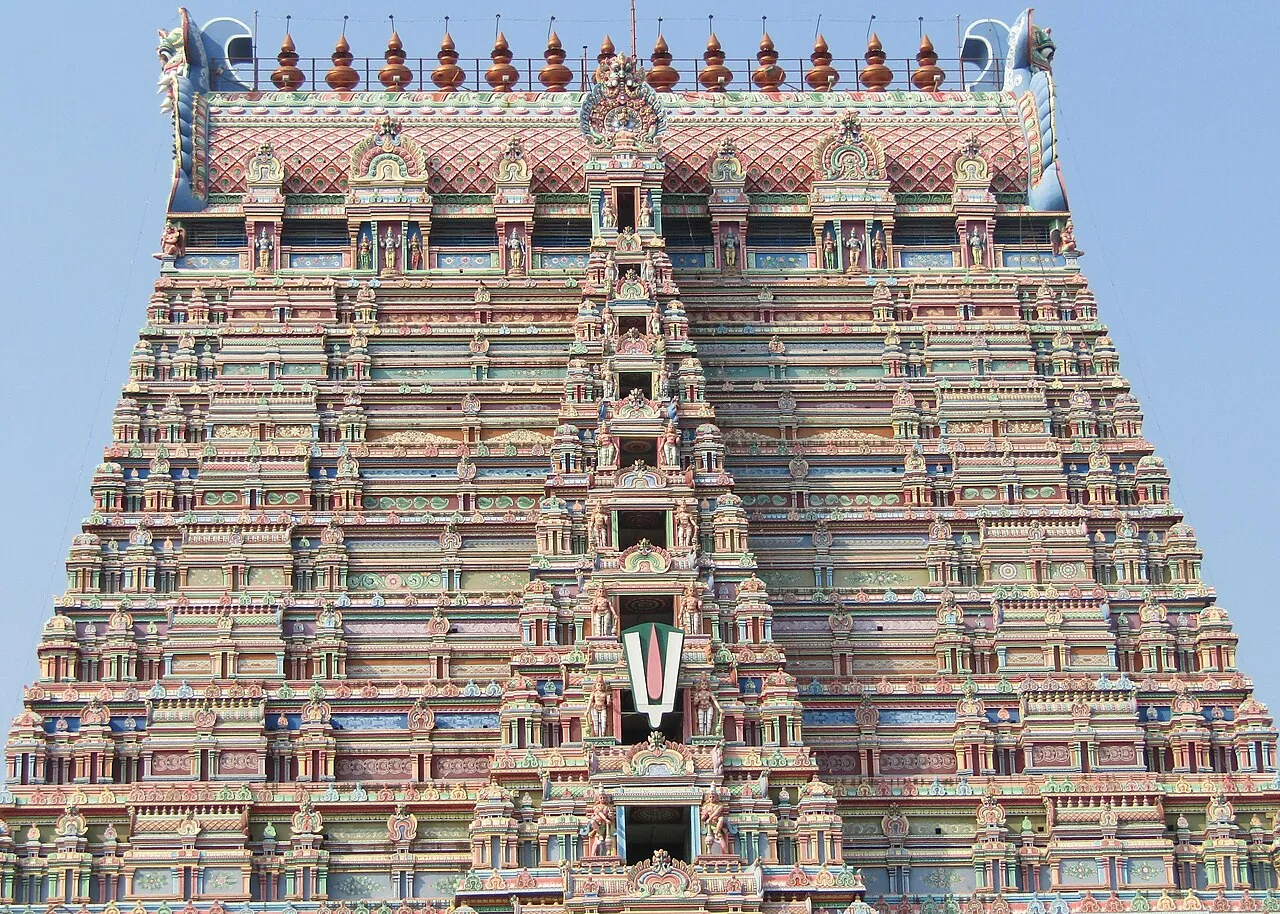
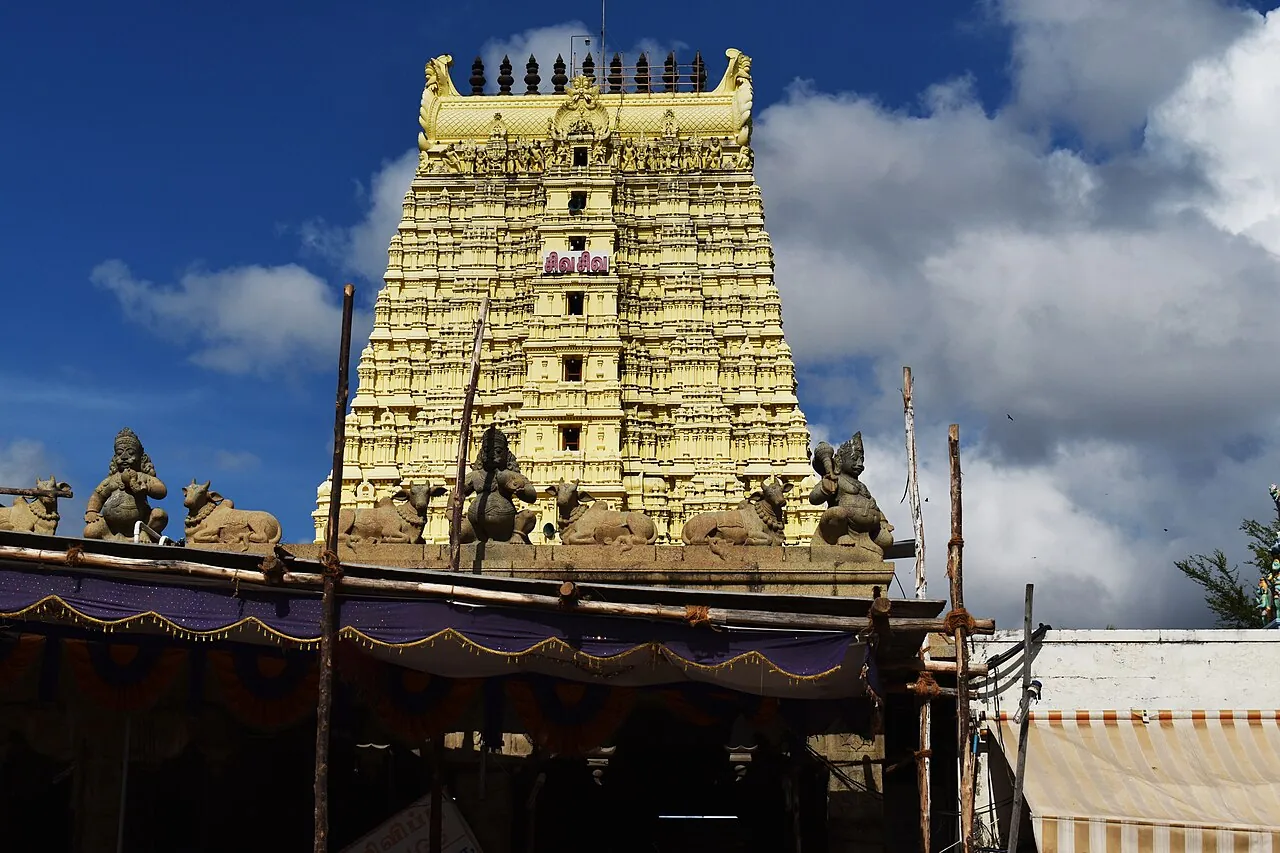
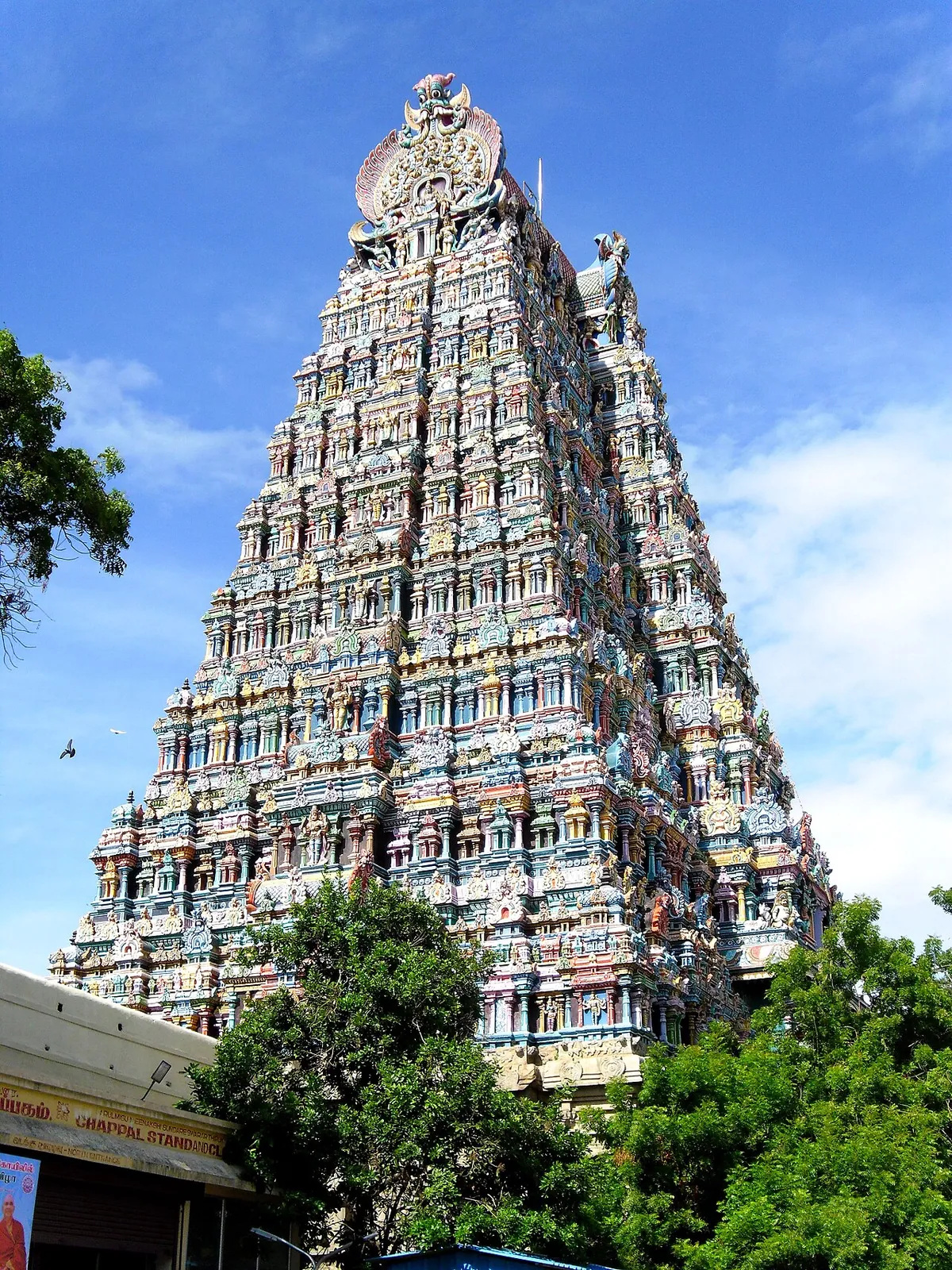
The HR&CE account records that sculptures and paintings were destroyed during Malik Kafur's invasion in the 14th century. The Thousand Pillar Hall was built in the time of Viswanatha Nayak, and Thirumalai Nayak (1623–1659) added the Pudhu Mandapam, the Raya Gopuram and the Teppakulam. The complex has 14 gopurams; the tallest, on the south, is 51.9 metres high.
The Chaitanya Charitamrita records that Sri Chaitanya Mahaprabhu visited Madurai, which it calls southern Mathura, on His South India tour. There He met a brahmana devoted to Lord Rama and later brought him a passage from the Kurma Purana explaining that Ravana never touched Sita Devi's spiritual form.
Highlights
- Goddess Meenakshi and Lord Sundareswarar worshipped together
- 14 gopurams; the southern tower is 51.9 metres high
- Thousand Pillar Hall of the Nayak period, with musical pillars
- Potramarai Kulam, the Golden Lotus Tank, inside the temple
- One of the 274 shrines sung in the Devaram hymns
- Meenakshi Thirukalyanam during the Chithirai festival
- Visited by Sri Chaitanya Mahaprabhu (southern Mathura)
Madurai Meenakshi
Origin legend and early history
According to the temple's HR&CE history, a merchant named Dhananjaya found a self-manifested (swayambhu) Shiva linga beside a pond in a Kadamba forest, where the devas were said to worship it. Temple tradition says Shiva then appeared in a dream to the Pandya king Kulasekara, who cleared the forest, built a great temple and laid out the city of Madurai around it.
A Kadamba tree in the northern prakaram is pointed to as a link with this forest. The HR&CE account also connects the old name Alavai with a legend of a serpent that held its tail in its mouth to mark the boundary of the city.
The temple is one of the 274 shrines praised in the Devaram hymns and is linked with the 64 divine sports (Thiruvilaiyadal) of Shiva. Madurai is described at length in Tamil literature, including Sangam works, the Kalladam, the Periyapuranam and Paranjothi Munivar's Thiruvilaiyadal Puranam.
Madurai Meenakshi
Meenakshi's reign and wedding
The temple tradition recorded by HR&CE says that Thadathagai, the princess born to Malayadhwaja Pandya and Kanchanamala, ruled the Pandya kingdom herself before going to Kailasa. Her divine marriage to Shiva is remembered at the festival of Panguni Uthiram.
According to the same tradition, Shiva then ruled Madurai as Sundara Pandya. Later He placed their son, Ugra Kumara Pandya, on the throne, and the divine couple remained in Madurai as Meenakshi and Sundareswarar.
Madurai Meenakshi
Architecture and halls
The HR&CE records date several gopurams to the Nayak period. The southern tower was built in 1559, in the time of Viswanatha Nayak. The seven-tier eastern gopuram of the Amman shrine dates to 1569, and the five-tier gopuram on the western Aadi street of the Amman shrine to 1570.
The Thousand Pillar Hall (Aayiram Kaal Mandapam) is carved with figures such as a horse rider, a Pandya king, Arjuna, Nartana Ganapathi and Rati. Tamil Nadu Tourism notes that some of its pillars are musical and give different notes when tapped.
Other halls listed by HR&CE include the Kambathadi Mandapam, carved with many forms of Shiva such as Ardhanari, Nataraja, Kalyanasundareswarar and Dakshinamurthy, as well as the Oonjal, Kilikoondu, Nootrukkal and Meenakshi Nayakar Mandapams. The corridor walls carry murals of the Thiruvilaiyadal Puranam.
Madurai Meenakshi
Festivals through the year
The Chithirai festival is the temple's most celebrated event. Tamil Nadu Tourism describes it as a 15-day celebration that begins with flag hoisting (Kodi Yetram), recreates the wedding of Meenakshi and Sundareswarar, and takes the divine couple around the streets of Madurai on a chariot. In its final days Lord Kallazhagar of Alagar Kovil arrives at the Vaigai river on a golden horse.
In 2026 the wedding was held on a stage on North Aadi Street on 28 April. The Hans India reported that the thali was tied to Goddess Meenakshi at about 8:55 AM, with Lord Perumal present among the processional Deities. Entry was free through the South Tower, and pass-holders (Rs 200 and Rs 500) entered through the West Tower.
Tamil Nadu Tourism also lists Avani Moolam (August–September), Navaratri (September–October) and the Masi Mandala Utsavam (February–March).
Madurai Meenakshi
Visitor guide
Early morning is the best time for darshan, according to Tamil Nadu Tourism, and October to March is the most pleasant season in Madurai. Tamil Nadu Tourism places the temple about 1 km from Madurai's main bus station and railway station, and about 11 km from the airport.
Mobile phones were banned inside the temple by order of the Madras High Court's Madurai Bench in 2018. Please check current phone, camera and dress rules at the entrance before you go in.
Nearby Vaishnava temples include Koodal Azhagar Temple in the city, Alagar Kovil and Thirumohoor Kalamegaperumal Temple. Tamil Nadu Tourism runs Hotel Tamilnadu properties in Madurai for pilgrims who want government accommodation.
Gallery
Madurai Meenakshi in pictures
Plan your darshan
Darshan & seva timings
- Morning darshan5:00 AM – 12:30 PM
- Evening darshan4:00 PM – 10:00 PM
Timings are as published on the temple's HR&CE website; daily pooja times may change during festivals. Please confirm current timings with the temple before you travel.
Main festivals
Chithirai festival (Meenakshi Thirukalyanam), about 15 days
Tamil month of Chithirai, April–May
Avani Moolam
August–September
Navaratri
September–October
Masi Mandala Utsavam
February–March
How to reach
Getting to Madurai Meenakshi
Plan the journey via Madurai, which has a railway station and an airport close to the temple. The station is about 1.6 km away and the airport about 11 km. Check current trains and flights from Visakhapatnam before you travel.
By road
The temple is in the centre of Madurai city.
By train
Madurai railway station is about 1.6 km from the temple.
By air
Madurai airport is about 11 km from the temple.
Location
Location & directions
Arulmigu Meenakshi Sundareswarar Temple, Madurai, Tamil Nadu 625001
Good to know
Frequently asked questions
When is the Meenakshi Thirukalyanam?
It is celebrated during the Chithirai festival in April–May. In 2026 the festival began with flag hoisting on 19 April and the Thirukalyanam took place on 28 April.
What are the temple's darshan hours?
According to the temple's HR&CE website, 5:00 AM to 12:30 PM and 4:00 PM to 10:00 PM, with changes on festival days.
How many gopurams does the Meenakshi temple have?
The temple has 14 gopurams. Tamil Nadu Tourism describes them as 45 to 50 metres tall, and the tallest, on the south, is 51.9 metres high.
Can I take my mobile phone inside the temple?
In 2018 the Madurai Bench of the Madras High Court ordered that mobile phones should not be carried inside, for the security of the temple, and the ban took effect on 3 March 2018. Please confirm the current rules and phone-deposit arrangements at the temple before you go.
What is the best time to visit the Meenakshi temple?
Tamil Nadu Tourism says early morning is the best time to visit the temple, and October to March is the best season to visit Madurai.
What is the Golden Lotus Tank?
The Potramarai Kulam, or Golden Lotus Tank, is the holy tank inside the temple. The HR&CE website lists it as one of the temple's specialities, along with the Teppakulam float tank.
Where can I stay near the Meenakshi temple?
Tamil Nadu Tourism lists its own Hotel Tamilnadu properties in Madurai, including one on West Veli Street near the Periyar bus stand. The temple is in the city centre, so there are many other options nearby.
Did Sri Chaitanya Mahaprabhu visit Madurai?
Yes. The Chaitanya Charitamrita (Madhya 9.178 and 9.210) records that He came to southern Mathura (Madurai), met a brahmana devoted to Lord Rama, and later returned there to give him a passage from the original Kurma Purana.