Overview
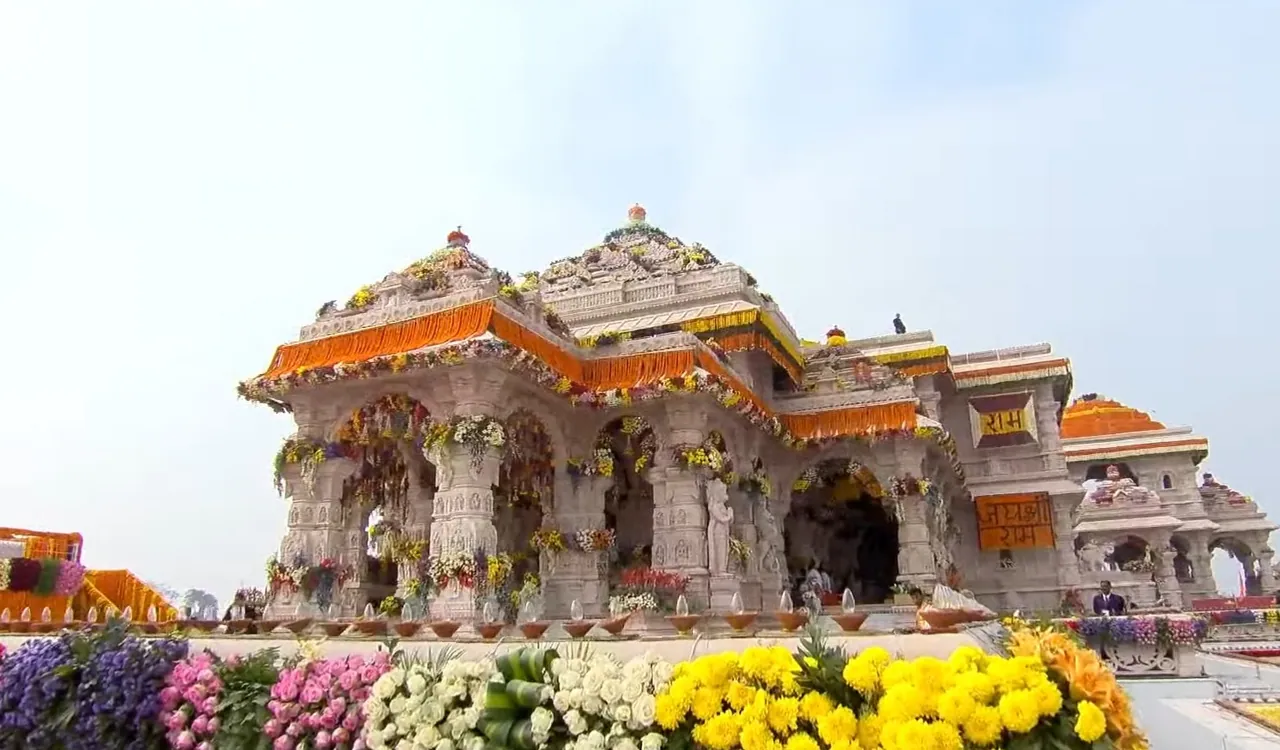
The temple at Lord Rama's birthplace in Ayodhya, consecrated on 22 January 2024, where He is worshipped as Ram Lalla, a five-year-old child.
History & significance
The story of Ram Mandir Ayodhya
The Srimad Bhagavatam (Ninth Canto, chapter 10) describes how Lord Ramachandra appeared as the son of King Dasharatha and ruled from Ayodhya after returning from the forest.
In November 2019 the Supreme Court of India ruled that the site be handed to a trust to be formed for building a temple to Lord Rama. The Pran Pratishtha, the consecration of the main Deity, took place on 22 January 2024. The temple is built in the Nagara style of North Indian temple architecture, based on an original design by the temple architect Chandrakant Sompura. The Deity of Ram Lalla, about 51 inches tall and carved from black stone by the Mysuru sculptor Arun Yogiraj, shows the Lord standing as a five-year-old child. A Ram Darbar on the first floor was opened to devotees in June 2025.
Highlights
- Pran Pratishtha on 22 January 2024
- Lord Rama worshipped as Ram Lalla, a five-year-old child
- Black stone Deity carved by Arun Yogiraj of Mysuru
- Nagara-style temple, 161 ft high, on 392 pillars with 44 doors
- No iron used anywhere in the temple
- Dharma Dhwaja hoisted on the shikhar on 25 November 2025
- Seven shrines (Sapt Mandir) to sages and devotees of Lord Rama
- Free darshan passes through the Trust's official portal
Ram Mandir Ayodhya
Building the temple
Work on the present temple began after the Bhoomi Pujan performed by Prime Minister Narendra Modi on 5 August 2020. Deccan Chronicle reported at the time that the original 1983 design by Chandrakant Sompura had been slightly modified for a three-storey, 161-ft temple on a raised platform.
The Shri Ram Janmabhoomi Teerth Kshetra Trust invited the Prime Minister for the Pran Pratishtha in October 2023. On 22 January 2024, at around noon, the Deity of Ram Lalla was consecrated in the ground-floor sanctum, with representatives of the country's major spiritual traditions present.
The Hans India reported that three sculptors each carved a Deity for the sanctum, and the Trust chose Arun Yogiraj's by vote. It is carved from Krishna shila stone from Bujjegoudanapura village in Mysuru district, and with its pedestal stands about 8 ft tall.
On 25 November 2025, Vivah Panchami, a saffron Dharma Dhwaja was hoisted on the shikhar, marking the completion of the temple's construction. The Prime Minister's Office describes it as a right-angled triangular flag, 10 ft high and 20 ft long, bearing a radiant sun, the syllable Om and the Kovidara tree.
Ram Mandir Ayodhya
Lord Rama in the Bhagavatam
The Srimad Bhagavatam (9.10.32–50) describes Lord Ramachandra's return to Ayodhya at the end of His exile with Lakshmana, Hanuman and Sugriva. Bharata came from Nandigrama carrying the Lord's wooden sandals, fell at His feet in tears, and the two brothers embraced for a long time.
The citizens greeted the Lord with flower garlands and danced in joy as He entered the city. Sage Vasishtha then bathed Him with water from the four seas, and the Lord accepted the throne of Ayodhya.
Ram Mandir Ayodhya
Architecture
According to the Prime Minister's Office, the temple is built in the traditional Nagara style. It is 380 ft long from east to west, 250 ft wide and 161 ft high, supported by 392 pillars and 44 doors. Its pillars and walls carry carved images of deities.
Pilgrims enter from the east, climbing 32 steps through the Singh Dwar. There are five mandapas: Nritya, Rang, Sabha, Prarthana and Kirtan. The foundation is a 14-metre layer of roller-compacted concrete, a 21-ft granite plinth guards against ground moisture, and no iron is used anywhere in the temple.
Around the temple runs an 800-metre parkota, or enclosure, built in the South Indian style. The outer walls of the main temple show 87 carved stone scenes from Lord Rama's life based on the Valmiki Ramayana, and 79 bronze panels line the enclosure walls.
Ram Mandir Ayodhya
Shrines in the complex
The Sapt Mandir is a group of seven shrines dedicated to Maharishi Vashishtha, Maharishi Vishwamitra, Maharishi Agastya, Maharishi Valmiki, Devi Ahalya, Nishadraj and Mata Shabari, who all appear in Lord Rama's pastimes.
In the south-west of the complex, on Kuber Tila, an ancient temple of Lord Shiva has been restored, with a statue of Jatayu beside it. Near the main temple is an old well known as Sita Koop.
Ram Mandir Ayodhya
Daily worship and aartis
Under the schedule the Trust announced from 1 November 2026, the doors open at 4:00 AM and Mangala aarti is at 4:30 AM. The Lord is then bathed, dressed and offered bhog, with Shringar aarti at 6:30 AM and general darshan from 7:00 AM.
Raj Bhog is offered late in the morning, with aarti at noon, followed by a rest period from 12:30 to 1:30 PM. Sandhya aarti is at 7:00 PM and Shayan aarti at 9:30 PM, and the doors close at 10:00 PM. Darshan pauses briefly for each bhog offering.
Ram Mandir Ayodhya
Festivals and nearby temples
On Rama Navami, the Lord's appearance day, a precisely aligned ray of sunlight falls on Ram Lalla's forehead as a Surya Tilak. At Diwali, Deepotsav lights the Ram ki Paidi ghats on the Saryu; Incredible India notes they entered the Guinness World Records for 22 lakh lamps lit there.
Near the temple, the Ayodhya district portal lists Kanak Bhawan, north-east of Ram Janmabhoomi in Ramkot, and Hanuman Garhi, about 1 km from Ayodhya railway station. Nageshwar Nath Temple stands at Ram ki Paidi.
Gallery
Ram Mandir Ayodhya in pictures
Plan your darshan
Darshan & seva timings
- Mangala aarti4:30 AM
- Shringar aarti; general darshan begins6:30 AM; 7:00 AM
- Raj Bhog aarti; rest period12:00 noon; 12:30 PM – 1:30 PM
- Sandhya aarti7:00 PM
- Shayan aarti; doors close9:30 PM; 10:00 PM
Schedule effective from 1 November 2026 as reported by The Hans India; darshan pauses briefly for bhog. The Trust revises timings by season, so please check its official notices before you travel.
Main festivals
Sri Rama Navami (Surya Tilak on Ram Lalla)
Chaitra Shukla Navami, March–April
Deepotsav (Diwali)
October–November
Vivah Panchami
Margashirsha Shukla Panchami, November–December
How to reach
Getting to Ram Mandir Ayodhya
Ayodhya is roughly 1,200–1,300 km from Visakhapatnam. Pilgrims usually take a train via Varanasi or Lucknow, or fly to Ayodhya or Lucknow via a connecting city.
By road
Ayodhya is connected by road to Lucknow and Varanasi, with buses and taxis.
By train
Ayodhya Dham Junction is the nearest railway station.
By air
Maharishi Valmiki International Airport, Ayodhya, is the nearest airport; Lucknow is another option.
Location
Location & directions
Shri Ram Janmabhoomi Mandir, Ram Kot, Ayodhya, Uttar Pradesh 224123
Good to know
Frequently asked questions
What are the Ram Mandir darshan timings?
From 1 November 2026: doors open around 4 AM for Mangala aarti, general darshan from 7 AM, doors close at 10 PM.
Do I need a pass for darshan?
Passes are free and are issued only through the Trust's official booking portal, online.srjbtkshetra.org.
Who carved the Ram Lalla Deity?
Mysuru sculptor Arun Yogiraj carved the 51-inch black stone Deity, chosen from three carved for the temple.
How big is the Ayodhya Ram Mandir?
According to the Prime Minister's Office, the temple is 380 ft long (east–west), 250 ft wide and 161 ft high, and stands on 392 pillars with 44 doors. It has five mandapas, and no iron is used anywhere in it.
What is in the Ram Darbar on the first floor?
The Ram Darbar shows Lord Rama in His royal form with Sita, Lakshmana, Bharata, Shatrughna and Hanuman. It opened to devotees in June 2025, initially with timed passes.
What is the Surya Tilak at Ram Mandir?
On Rama Navami, a precisely aligned ray of sunlight falls on the forehead of Ram Lalla as a tilak marking the Lord's appearance day, as described by Incredible India.
Which shrines are inside the Ram Mandir complex?
Besides the main temple there is a Sapt Mandir of seven shrines to Maharishi Vashishtha, Vishwamitra, Agastya and Valmiki, Devi Ahalya, Nishadraj and Mata Shabari, and a restored ancient Shiva temple on Kuber Tila with a statue of Jatayu.
Which temples can I visit near Ram Mandir?
The Ayodhya district portal lists Hanuman Garhi (about 1 km from Ayodhya railway station), Kanak Bhawan (north-east of Ram Janmabhoomi in Ramkot), Nageshwar Nath Temple and the Ram ki Paidi ghats on the Saryu.