Overview
Lord Krishna's royal home on the Gujarat coast, worshipped as Dwarkadhish, the King of Dwaraka, where the Gomti river meets the Arabian Sea.
History & significance
The story of Dwarkadhish
The Srimad Bhagavatam (Tenth Canto, chapter 50) describes how Lord Krishna had a fortified city built within the sea and brought His family and the Yadus to live there safely. That city was Dwaraka, where the Lord lived as a king, and the temple at Dwarka is dedicated to Him as Dwarkadhish, the Lord of Dwaraka.
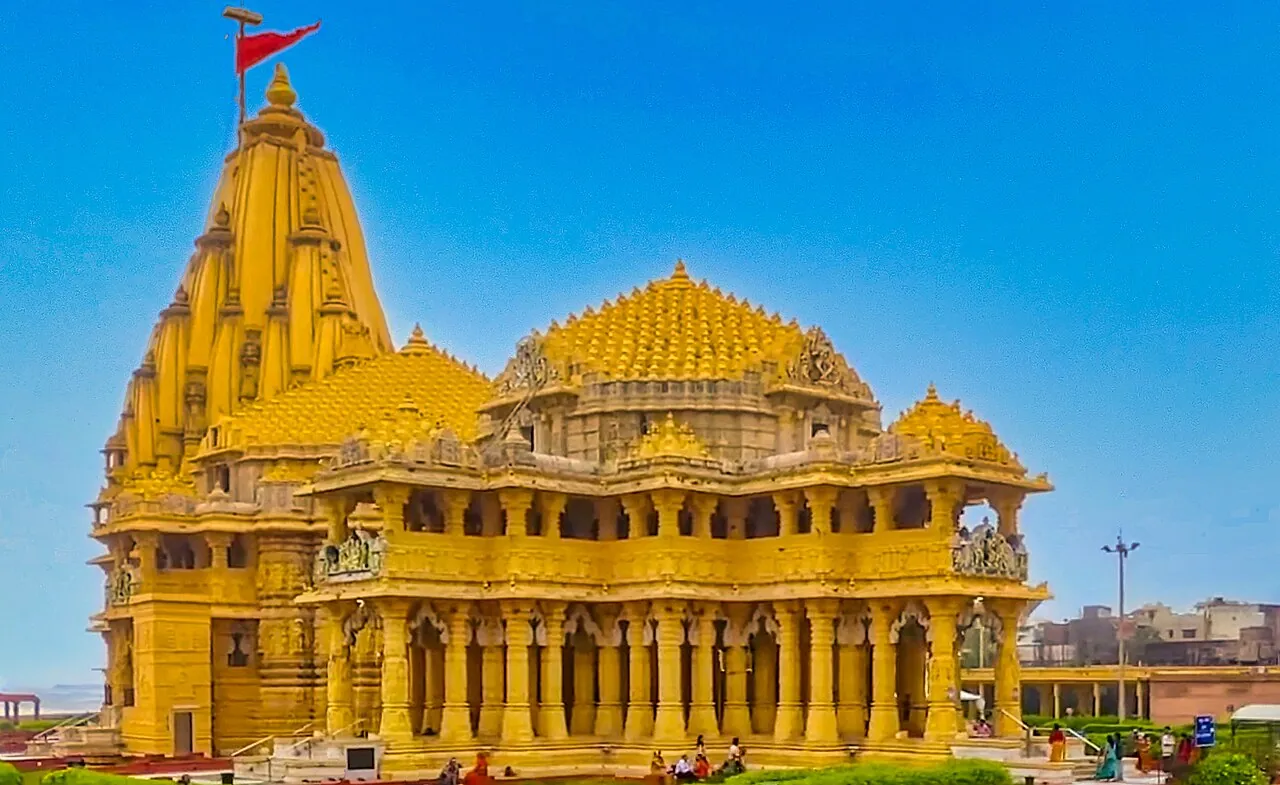
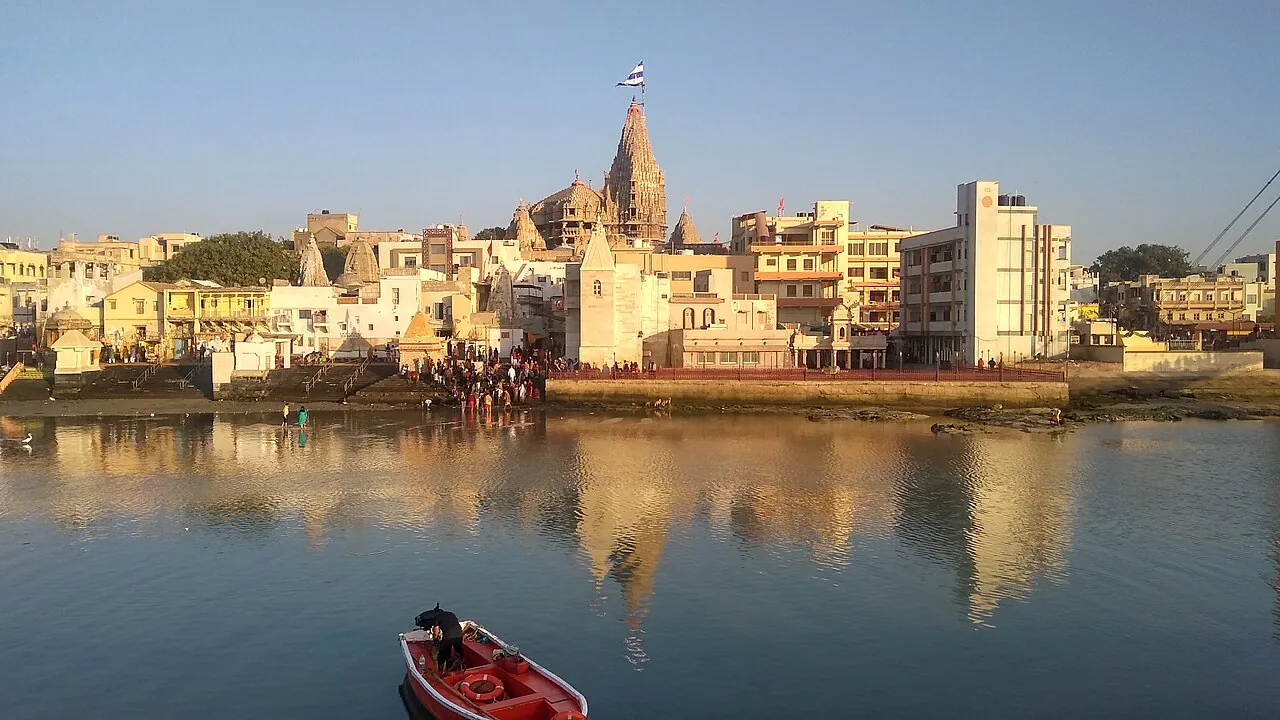
According to temple tradition, as presented by Gujarat Tourism, the shrine was first established more than 2,500 years ago by Vajranabha, the great-grandson of Lord Krishna. The temple, also called Jagat Mandir, stands where the Gomti river meets the Arabian Sea. Its spire rises about 43 m, and a flag made from 52 yards of cloth flies at the top. Pilgrims pass through two doors: the Swarga Dwar and the Moksha Dwar.
Highlights
- Lord Krishna worshipped as the King of Dwaraka
- Spire about 43 m high with a 52-yard flag
- Stands where the Gomti river meets the Arabian Sea
- Two doors: Swarga Dwar and Moksha Dwar
- Five-storey temple resting on 72 pillars
- Seven-coloured flag bearing the sun and moon, changed five times a day
- One of the Char Dham, with Badrinath, Puri and Rameswaram
- Run by a Devasthan Samiti headed by the District Collector
Dwarkadhish
History in detail
The temple's own history page records a long line of renovations. It says Adi Shankaracharya renovated the shrine around 800 CE and set up a shrine of Adyashakti on the fourth floor, and that Queen Minaldevi renovated it again around 1120 CE.
Gujarat Tourism notes that the original structure was destroyed by Mahmud Begada in 1472 and rebuilt in the 15th–16th century, and that the present temple shows work from the 16th and 19th centuries. The temple's history page adds that Maharaja Khanderao renovated it in 1861, and that in 1903 a Gaekwad Maharaja had a golden kalasha placed on the summit.
Today, according to the temple's website, the Government of Gujarat is the sole trustee. A Devasthan Samiti, with the Collector of Devbhumi Dwarka district as president and a Deputy Collector-level officer as administrator, handles daily affairs, rituals and development work.
Dwarkadhish
Dwaraka in the Bhagavatam
The Srimad Bhagavatam (10.50.49–57) describes how Lord Krishna had a fort twelve yojanas around built within the sea. The architect of the demigods, Visvakarma, laid out wide avenues, parks and golden-roofed homes, each with its own household temple. Indra offered the Sudharma assembly hall and the parijata tree, and the Lord moved all the citizens there by His Yogamaya.
The First Canto (chapter 11) describes the Lord's return to Dwaraka from Hastinapura. He sounded His conchshell at the border, and the citizens ran out with gifts, calling Him their protector and father, while the city was decorated with flags, garlands and arches of mango leaves.
Dwarkadhish
Architecture
Incredible India describes Jagat Mandir as a five-storey temple of limestone and sand, resting on 72 pillars and built in the Chalukya style. Gujarat Tourism notes that it stands on a small hill reached by more than 50 steps, with heavily carved walls around the sanctum and smaller shrines across the complex.
The flag on the spire is famous in its own right. The temple's website describes it as 52 yards long, in seven colours, showing the sun and the moon. According to the temple, the 52 sections stand for the 52 administrative divisions of the Yadavas in Lord Krishna's Dwaraka. Devotees who wish to sponsor a flag (dhwaja arohan) are directed to the office of the Shree Guggali 505 Samiti in Dwarka.
Dwarkadhish
Daily worship and darshan
The temple's published time table begins with Mangla aarti at 6:30 AM. Through the morning the doors close briefly for abhishek, snan bhog, shringar bhog, gwal bhog and raj bhog, with Shringar aarti at about 10:30 AM. The sanctum closes for anosar at 1:00 PM.
Evening darshan opens with Uthappan at 5:00 PM. Sandhya aarti is at 7:30 PM and Shayan aarti at 8:30 PM, and the temple closes at 9:30 PM. The temple website also streams live darshan.
Dwarkadhish
Festivals through the year
The temple's festival page calls Janmashtami its most important festival, when thousands of pilgrims come for darshan. In Kartika the year opens with special decoration on New Year's Day, followed by Annakut, when hundreds of food preparations are offered, and Tulsi Vivah.
From Akshaya Tritiya the Lord wears flower garments and gives Chandan darshan, until Bhima Ekadashi. Holi and Dhuleti, Rama Navami with a special afternoon aarti, the Rath Yatra on Ashadha Shukla Dwitiya, Vamana Jayanti, Dussehra and the Diwali days are also celebrated, and the whole month of Dhanur Masa is observed.
Dwarkadhish
Visitor guide
Gujarat Tourism suggests visiting between November and February. Pilgrims pass through the two doors, Swarga Dwar and Moksha Dwar. Sudama Setu, at the base of the temple, crosses the Gomti creek towards the beach.
The temple's Dwarka Darshan list includes Rukmini Mandir, Gomti Ghat, Sharada Peeth, Gayatri Mandir, Gita Mandir and Bhadkeshwar Mahadev in town. Further out are Nageshwar Jyotirlinga, Gopi Talav and the island of Beyt Dwarka with its own Dwarkadhish shrine.
Gallery
Dwarkadhish in pictures
Plan your darshan
Darshan & seva timings
- Mangla aarti6:30 AM
- Morning darshan (with short closures for bhog)about 7:00 AM – 1:00 PM
- Evening darshan (Uthappan to closing)5:00 PM – 9:30 PM
- Sandhya aarti; Shayan aarti7:30 PM; 8:30 PM
Schedule as published on the temple's own website, dwarkadhish.org. Darshan pauses several times a day for bhog offerings, and Gujarat Tourism lists slightly shorter hours (7:00 AM – 12:30 PM and 5:00 PM – 9:00 PM). Please confirm current timings with the temple before you travel; they change on festival days, eclipses and special occasions.
Main festivals
Sri Krishna Janmashtami (the temple's most important festival)
Bhadrapada Krishna Ashtami, August–September
Holi and Dhuleti
Phalguna Purnima and the next day, February–March
Annakut
Day after Diwali, October–November
Tulsi Vivah
Kartika Shukla Ekadashi to Purnima, October–November
Akshaya Tritiya (Chandan darshan; flower dress begins)
Vaisakha Shukla Tritiya, April–May
Rath Yatra
Ashadha Shukla Dwitiya, June–July
Rama Navami (special afternoon aarti)
Chaitra Shukla Navami, March–April
How to reach
Getting to Dwarkadhish
Dwarka is roughly 2,100 km from Visakhapatnam. Most pilgrims fly to Jamnagar, Porbandar or Rajkot via a connecting city, or take a train towards Ahmedabad and continue to Dwarka.
By road
State buses and taxis connect Dwarka with Jamnagar, Porbandar and Rajkot.
By train
Dwarka has its own railway station, a short distance from the temple.
By air
Porbandar airport is about 95 km away and Jamnagar airport about 145 km away.
Location
Location & directions
Shri Dwarkadhish Temple, Dwarka, Devbhumi Dwarka district, Gujarat 361335
Good to know
Frequently asked questions
What are the Dwarkadhish temple timings?
The temple's website lists Mangla aarti at 6:30 AM, morning darshan until about 1:00 PM and evening darshan from 5:00 PM to 9:30 PM, with short closures for bhog. Please confirm before you go, as timings change on festival days.
What is Sudama Setu?
A footbridge near the temple across the Gomti creek. Gujarat Tourism lists it as open about 7 AM – 1 PM and 4 – 7:30 PM.
What is the nearest airport to Dwarka?
Porbandar (about 95 km) and Jamnagar (about 145 km) are the nearest airports.
Who built the Dwarkadhish temple?
According to temple tradition, Vajranabha, Lord Krishna's great-grandson, first established the shrine. Gujarat Tourism records that the old structure was destroyed in 1472 by Mahmud Begada and rebuilt in the 15th–16th century, with later renovations.
Why does the Dwarkadhish flag have 52 yards of cloth?
The temple's website explains that the 52 sections are said to stand for the 52 administrative divisions of the Yadavas in Lord Krishna's Dwaraka. The flag has seven colours and shows the sun and moon. Incredible India says it is changed five times a day.
Who manages the Dwarkadhish temple?
According to the temple's website, the Government of Gujarat is the sole trustee, and a Devasthan Samiti headed by the Collector of Devbhumi Dwarka district runs daily affairs and rituals.
What is the best time to visit Dwarka?
Gujarat Tourism suggests November to February. Janmashtami is the biggest festival at the temple, so expect large crowds then.
Which places can I visit near the Dwarkadhish temple?
The temple's Dwarka Darshan list includes Rukmini Mandir, Gomti Ghat, Sharada Peeth, Gita Mandir, Bhadkeshwar Mahadev and Sudama Setu in town, and Nageshwar Jyotirlinga, Gopi Talav and Beyt Dwarka nearby.