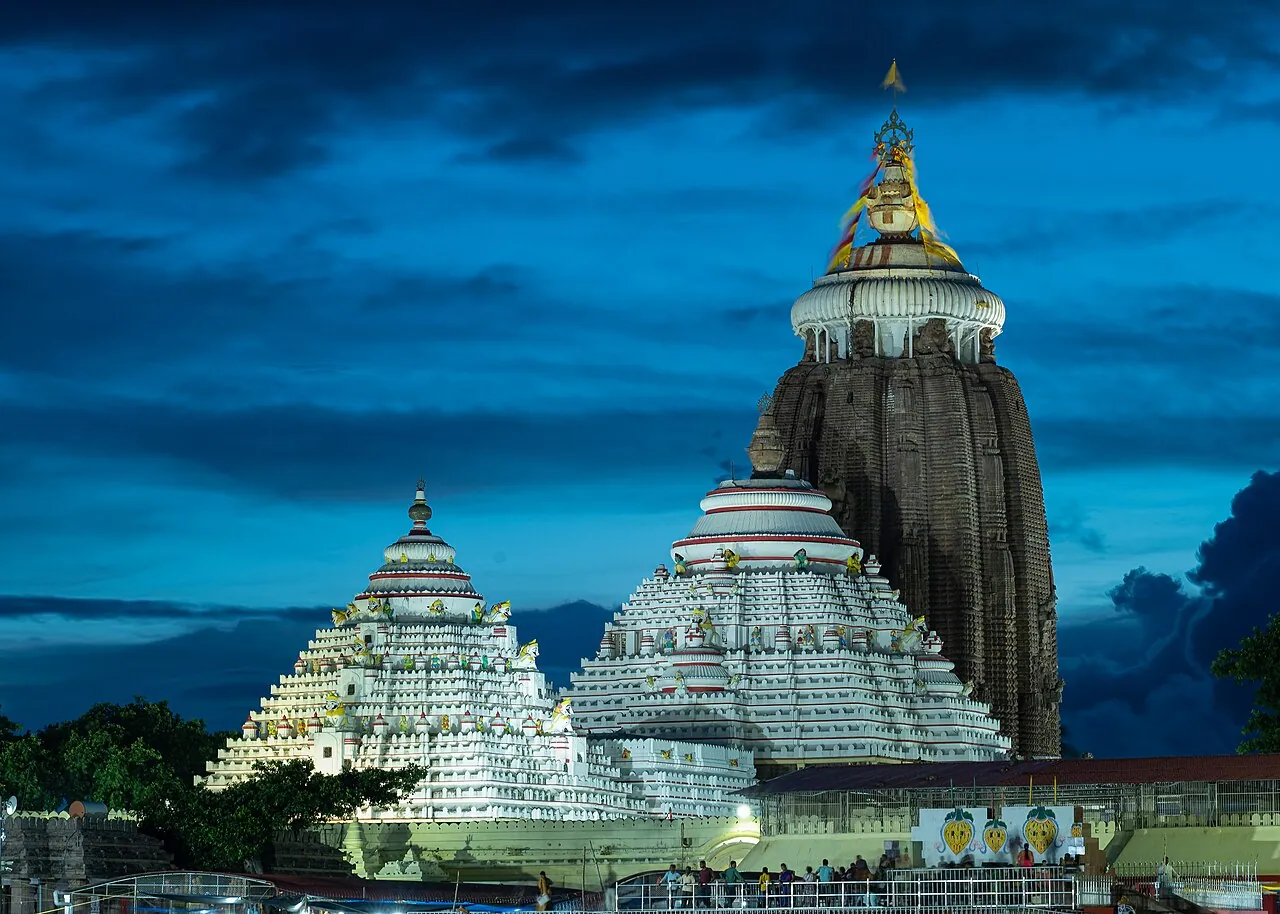
Overview
The temple of Lord Jagannath, Balabhadra and Subhadra in Puri, Odisha, one of the four dhams, famed for Ratha Yatra and for Sri Chaitanya Mahaprabhu's long stay.
History & significance
The story of Puri Jagannath
Puri is known as Purushottama Kshetra and also as Neelachala, and the Shree Jagannatha Temple Administration describes it as one of the four dhams of India, with Dwarka, Badrinath and Rameswaram. The temple administration's account of the tradition tells of King Indradyumna, who set out to find the Lord worshipped as Purushottama. A great divine log of wood appeared on the seashore, and according to temple tradition Lord Vishnu Himself came in the guise of a carpenter and carved the Deities.
The administration records that the present temple was built in the 12th century by King Anantavarman Chodaganga Deva and completed by Anangabhima Deva III around 1230. The Deities are carved from neem wood and are replaced in the Nabakalebara ceremony, which usually takes place in a year when an extra (leap) month falls in Ashadha.
Sri Chaitanya Mahaprabhu came to Puri during the reign of King Prataparudra and spent the rest of His life there. The Chaitanya Charitamrita describes how He chanted and danced with His associates before Lord Jagannath's chariot at Ratha Yatra.
Highlights
- One of the four dhams, also called Purushottama Kshetra
- Ratha Yatra on the second day of the bright fortnight of Ashadha
- Sri Chaitanya Mahaprabhu lived in Puri in His later years
- Deities of neem wood, renewed in the Nabakalebara ceremony
- Main temple about 214 feet high, in the Kalinga style
- Temple kitchen (Roshaghara) with about 240 hearths
- Declared a National Monument in 1975
Puri Jagannath
Architecture of the Shreemandira
The temple administration describes the Shreemandira as one of the most refined examples of Kalinga temple architecture. The sanctum (vimana or deula) is a rekha deula with a curved tower, and the porch (jagamohana) is a pidha deula with a pyramid-shaped roof. With the natamandapa (audience hall) and bhogamandapa (offering hall), the four halls stand in a row from east to west on a raised platform.
The main temple rises about 214 feet 8 inches above road level. Two walls enclose the complex: the outer Meghanada Prachira (665 ft x 640 ft, 20–24 ft high) and the inner Kurma Prachira (420 ft x 315 ft). The outer wall has four gates: the Singha Dwara (Lion's Gate) on the east, the Aswa Dwara on the south, the Vyaghra Dwara on the west and the Hasti Dwara on the north.
In front of the eastern side stands the Aruna Stambha, a sixteen-sided monolithic pillar about 34 feet tall, brought from Konark in the reign of Dibyasingha Deva (1793–98). The temple was declared a National Monument in 1975, and its conservation was entrusted to the Archaeological Survey of India in 1979.
Puri Jagannath
Shrines inside the complex
The temple administration notes that hundreds of smaller shrines and mandapas stand within the walls. The Vimala temple, facing east in the inner compound, is described as the oldest of them, and the prasad of Lord Jagannath is offered to Vimala. Goddess Lakshmi is worshipped as Gajalakshmi in her own temple in the north-west corner of the inner enclosure.
Other sacred places include the Kalpabata, a banyan tree on the south side named in the Skanda and Brahma Puranas, and Koili Baikuntha on the north, where new Deities are carved and the old ones are buried during Nabakalebara. Pilgrims climb the Baisi Pahacha, the eastern flight of steps from the outer to the inner enclosure.
Puri Jagannath
Daily rituals and Mahaprasad
About 85 to 90 sevakas take part in the daily rituals (niti). After the doors are opened and Mangala Alati is offered, the Deities are bathed and dressed, and a series of bhogas follows: Gopal Ballav Bhoga around 8:30 AM, the Sakala Dhupa or Raj Bhoga from 9 to 10 AM, the Bhoga Mandap offering around 11:30 AM, the Madhyahna Dhupa, and the Sandhya Dhupa in the evening. At night the Deities wear silk and flower garlands for the Badasinghara Besha before they retire around 11:30 PM.
The temple kitchen, the Roshaghara, is popularly considered the largest kitchen in the world. It has about 240 hearths, food is cooked over firewood in earthen pots, and only the servitors called Suaras may cook there. The Bhoga Mandap offering is prepared mainly for pilgrims and mathas, and Mahaprasad is sold at Ananda Bazar in the north-east corner of the outer compound.
Puri Jagannath
Ratha Yatra and the festival year
On Ashadha Shukla Dwitiya the Deities ride their chariots, Nandighosa, Taladhwaja and Darpadalana, to the Gundicha temple about 3 km away. The Gajapati Maharaja sweeps the chariots with a golden broom and sprinkles sandal paste in the Chhera Pahanra ritual. Hera Panchami follows during the Deities' nine-day stay, and on Ashadha Shukla Dashami they return in the Bahuda Yatra.
The next day, Suna Besha, the Deities are adorned with gold ornaments on the chariots in front of the Lion's Gate. On the 13th day of the bright fortnight they return to the jewelled throne in the Niladri Bije procession. Earlier in the year, at Snana Yatra on Jyeshtha Purnima, the Deities are bathed with 108 pitchers of water on the Snana Mandapa.
Nabakalebara, the renewal of the wooden Deities, falls at intervals of 8, 11, 12 or 19 years. It begins with the Banajaga Yatra on Chaitra Shukla Dashami, when servitors set out to find four sacred neem trees.
Puri Jagannath
Sri Chaitanya Mahaprabhu in Puri
The Chaitanya Charitamrita records that Sri Chaitanya Mahaprabhu lived continuously in Jagannatha Puri for eighteen years, leading His devotees in kirtana. Before Ratha Yatra He personally washed and cleaned the Gundicha temple with His associates, using a hundred new waterpots and brooms supplied by the temple superintendent, Kashi Mishra. This cleaning of the Gundicha temple is described in Madhya-lila, chapter 12.
Puri Jagannath
Visitor guide
The temple administration asks pilgrims to bathe and wear clean clothes, follow the queue, keep silence inside and avoid carrying food, footwear, leather items, umbrellas, phones and other gadgets. Free shoe and mobile stands are provided near the Lion's Gate barricade and near the temple office. Beware of pickpockets and monkeys.
Free battery-operated vehicles carry senior citizens and differently abled devotees from Jagannatha Ballav Parking (Market Square) to the temple, and wheelchairs with ramp access are available at the North Gate. A free first-aid post with a physician works at the temple branch office.
For a stay close to the temple, the administration runs Nilachal Bhakta Niwas on Grand Road next to the temple, Shree Gundicha Bhakta Niwas near the Gundicha temple, Neeladri Bhakta Niwas near the Town Police Station and Purushottam Bhakta Niwas near the Old Jail.
Gallery
Puri Jagannath in pictures
Plan your darshan
Darshan & seva timings
- Doors opened (Dwarafita), per the temple's prescribed scheduleby 4:30 AM
- Mangala Alati5:30 AM
- Sandhya Alati6:00 PM
- Pahuda (Deities retire, doors sealed)11:30 PM
These times are from the Shree Jagannatha Temple Administration's daily ritual schedule, which itself notes that they are not always followed exactly. Darshan pauses for offerings during the day. Please confirm current timings with the temple before you travel.
Main festivals
Ratha Yatra
Ashadha Shukla Dwitiya, June–July
Bahuda Yatra (return journey)
Ashadha Shukla Dashami, nine days after Ratha Yatra
Suna Besha (golden attire on the chariots)
Ashadha Shukla Ekadashi
Snana Yatra
Jyeshtha Purnima, May–June; darshan then pauses for about 15 days
Chandan Yatra
Begins on Akshaya Tritiya and lasts 42 days, April–June
Dola Yatra
Phalguna Shukla Dashami to Purnima, February–March
Pushyabhisheka
Pausha Purnima, December–January
Nabakalebara (renewal of the Deities)
Usually in a year with a leap month in Ashadha
How to reach
Getting to Puri Jagannath
The Puri district administration notes that there are direct buses between Puri and Visakhapatnam. Puri is a terminus on the East Coast Railway, and Khurda Road junction is 44 km from Puri.
By road
Buses from the stand near the Gundicha Temple run to Bhubaneswar and Cuttack every 10–15 minutes.
By train
Puri railway station is a terminus on the East Coast Railway; Khurda Road junction, 44 km away, serves trains towards Chennai and western India.
By air
Puri has no airport. The nearest is Biju Patnaik International Airport, Bhubaneswar, about 60 km away.
Good to know
Frequently asked questions
Who can enter the Puri Jagannath temple?
According to the temple administration's FAQ, only Hindus are allowed inside the temple. Those who cannot enter can have darshan of Patitapabana, an image of Lord Jagannath in a niche on the eastern gate.
What should I not carry into the temple?
The temple's list of don'ts includes umbrellas, mobile phones, electronic gadgets and leather items, and footwear is not allowed in or around the temple. Bathe and wear clean clothes before entering. Free shoe and mobile stands are provided near the Lion's Gate.
Is darshan available throughout the year?
No. After Snana Yatra on Jyeshtha Purnima, the temple administration says darshan of the Deities is not available for about 15 days.
What are the darshan timings at Puri?
The temple administration says darshan is available almost throughout the day, from about 5:30 AM until late night, except on some festival days. Darshan pauses from about 8:00 to 9:15 AM for the Gopal Ballava offering.
What are the names of the three chariots?
Lord Jagannath's chariot is Nandighosa, Lord Balabhadra's is Taladhwaja and Subhadra Devi's is Darpadalana.
How long do the Deities stay at the Gundicha Temple?
Nine days. The Deities leave on Ashadha Shukla Dwitiya and return in the Bahuda Yatra on Ashadha Shukla Dashami.
Where can I get Jagannath Mahaprasad?
At Ananda Bazar, in the north-east corner of the temple's outer compound, where Mahaprasad is sold and devotees may also sit and eat it.
Does the temple run guest houses?
Yes. The temple administration lists Nilachal Bhakta Niwas, Shree Gundicha Bhakta Niwas, Neeladri Bhakta Niwas and Purushottam Bhakta Niwas, with online booking at stayatpurijagannatha.in.