Brahma-Madhva-Gaudiya Sampradaya
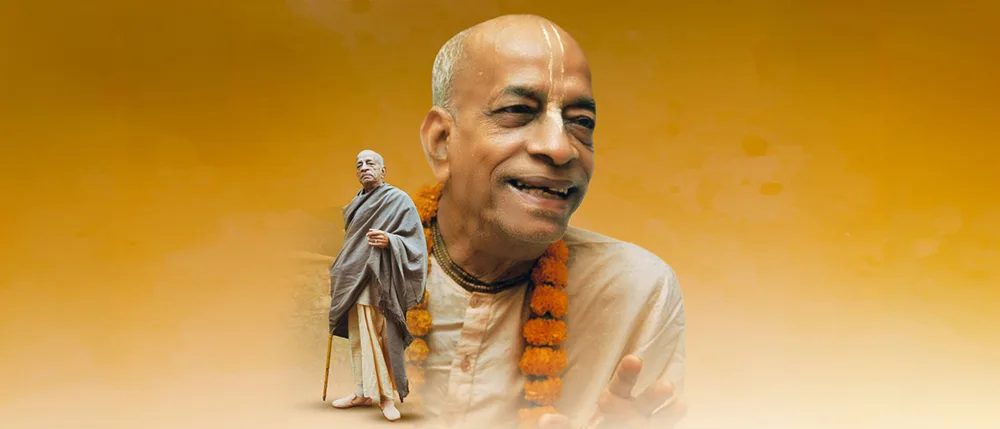
A. C. Bhaktivedanta Swami Prabhupada
Founder-Acharya of ISKCON
Also known as Srila Prabhupada
Appearance
September 1, 1896
Calcutta, Bengal Presidency, British India
Disappearance
November 14, 1977
Vrindavan, Uttar Pradesh, India
Guru
Bhaktisiddhanta Sarasvati
ViewCategory
Founder-Acharya
View
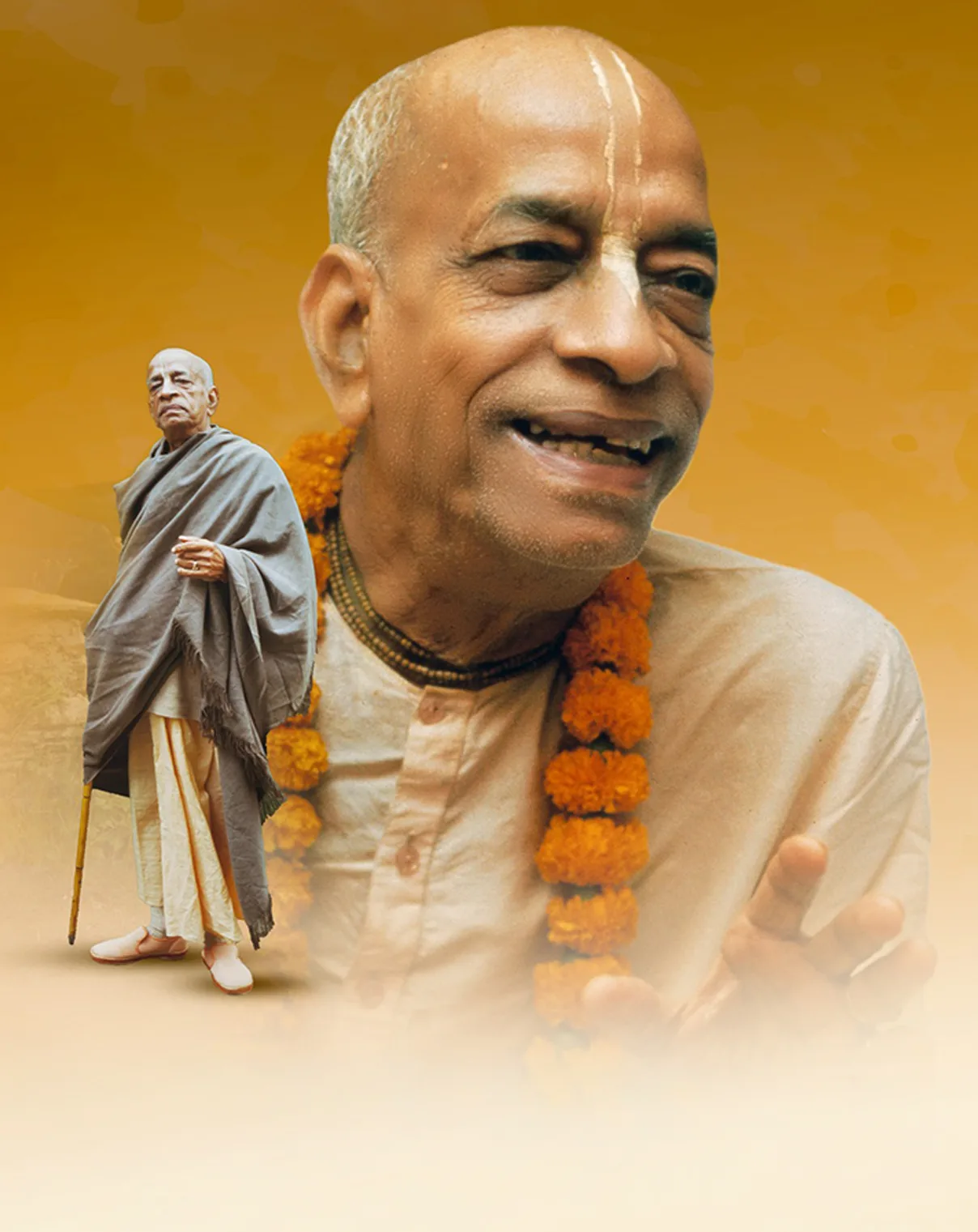
A. C. Bhaktivedanta Swami Prabhupada, widely known as Srila Prabhupada, was the Founder-Acharya of the International Society for Krishna Consciousness (ISKCON). He brought the teachings of Lord Sri Krishna and the practice of bhakti-yoga to people throughout the world.
His life
Biography
Śrīla Prabhupāda, the Founder-Ācārya of the International Society for Krishna Consciousness (ISKCON), has been described as a scholar, philosopher, cultural ambassador, author, spiritual teacher and social critic. He was all of these, but above all he was a pure devotee of Lord Kṛṣṇa and a bona fide spiritual master in the Gauḍīya Vaiṣṇava sampradāya.
More than five hundred years ago Śrī Caitanya Mahāprabhu inaugurated the saṅkīrtana movement, the congregational chanting of the holy names, as the dharma for the age of Kali. He foretold that the holy name would be heard in every town and village of the world, and that a powerful servant would come to carry it there. Beginning at the age of sixty-nine with almost nothing, Śrīla Prabhupāda spread Kṛṣṇa consciousness across the world in about a dozen years, fulfilling that prophecy.
Appearance in Calcutta
Śrīla Prabhupāda appeared on 1 September 1896, the day after Janmāṣṭamī, in a small house in Tollygunge, a suburb of Calcutta. His parents, Gour Mohan De and Rajani, named him Abhay Charan, meaning one who is fearless because he has taken shelter at the lotus feet of Kṛṣṇa.
An astrologer who cast the child's horoscope predicted that at the age of seventy he would cross the ocean, become a great teacher of religion, and establish 108 temples of Kṛṣṇa. Seven decades later the prediction came true in every detail.
A Childhood Steeped in Devotion
His father, Gour Mohan De, was a pure devotee of the Lord. When Abhay was four or five, his father gave him small Deities of Rādhā and Kṛṣṇa. With his sister, Abhay worshipped Them in play, copying the ceremonies he saw at the neighbouring Rādhā-Govinda temple. Through this daily play he developed a natural attraction to the Lord. Even as a toddler he joined the kīrtanas held in the family home.
Śrīla Prabhupāda later remembered how, during the terrible plague of 1898, a bābājī led Hare Kṛṣṇa saṅkīrtana through the streets of Calcutta. People of every faith joined in, and he recalled that the epidemic subsided. When he fell ill with typhoid as a baby, a doctor prescribed chicken broth. His father refused, and when the broth was given anyway, the child vomited it at once.
The family was not wealthy, but under his father's care the children never felt any lack. When Abhay was six, his father gave him a small chariot, and the boy organised his own Ratha-yātrā festival for the neighbourhood children, with his father generously supplying prasāda. His father also had him taught the mṛdaṅga, despite his mother's objections. To every saintly visitor his father made one request: please bless my son to become a servant of Śrīmatī Rādhārāṇī. Śrīla Prabhupāda felt deeply indebted to his father for this training and later dedicated his Kṛṣṇa book to him.
Education and the Freedom Movement
In 1916 Abhay entered the prestigious Scottish Churches' College in Calcutta to study philosophy. In 1918, while still in college, he was married to Radharani Datta, as arranged by his father.
In 1920 Mahatma Gandhi launched the non-cooperation movement against British rule, calling on Indians to boycott English schools, courts and goods. Leaders such as Motilal Nehru and C. R. Das gave up wealthy careers to join him, and foreign cloth was burned in public bonfires. Abhay was among the students who answered the call. He left his English education and began wearing hand-spun khadi.
Meeting His Spiritual Master
In 1922 his close friend Narendranath Mullik urged him to meet a sādhu from Māyāpur. Having met many false sādhus, Abhay was reluctant, but he agreed to go. In the āśrama they found Śrīla Bhaktisiddhānta Sarasvatī Ṭhākura, a scholarly sannyāsī sitting very straight and wearing small round spectacles.
Even before the young men had been introduced, Bhaktisiddhānta Sarasvatī asked them why, as educated young men, they did not preach Kṛṣṇa's message throughout the world. Abhay replied that India first had to become independent, since no one would listen to a subject nation. Bhaktisiddhānta Sarasvatī answered calmly that Kṛṣṇa's message could not wait for political change; it did not depend on who ruled, and the teachings of the Bhagavad-gītā were too important to wait.
As they walked away, Narendranath asked his friend what he thought. Abhay replied, "The message of Bhagavad-gita is in the hands of a very expert person." In his heart he accepted Bhaktisiddhānta Sarasvatī as his spiritual master that day, and in 1933 he received formal initiation from him.
The Final Order
As a householder Abhay supported his guru's mission with donations, but he longed to serve more directly. In December 1936 he wrote to Bhaktisiddhānta Sarasvatī asking how he could do so. The reply, which reached him around the time of his spiritual master's departure from this world, repeated the instruction of their first meeting: to preach what he had learned to the English-speaking world, for his own good and for the good of those who heard him. Śrīla Prabhupāda accepted this as his guru's final order and made it the mission of his life.
Preaching in India
In the following years he wrote a commentary on the Bhagavad-gītā and continued to help the Gauḍīya Maṭh. In 1944 he started Back to Godhead magazine to show the public that material life is not the only reality and that the real goal of life is to return to Kṛṣṇa. He did everything himself. He wrote and edited the articles, typed the manuscripts, checked the proofs, and distributed the copies by hand. During the Second World War, when paper was scarce and the government refused him paper, he wrote to the authorities three times until permission was granted.
Few people were interested, and even his family showed little sympathy for his mission. He founded a centre called the League of Devotees in Jhansi, but it did not succeed and he had to close it. Gradually he withdrew from family life to give himself fully to preaching.
Vṛndāvana and Sannyāsa
He moved to Vṛndāvana and lived very simply at the historic Rādhā-Dāmodara temple, the temple of Śrīla Jīva Gosvāmī. With no income, he ate little, wore old cloth and spent his years studying and writing, collecting money only to print books. In 1959 he accepted sannyāsa. The following year he began his multi-volume translation and commentary on the eighteen-thousand-verse Śrīmad-Bhāgavatam. He also wrote Easy Journey to Other Planets. He personally presented a copy of the Śrīmad-Bhāgavatam to Prime Minister Lal Bahadur Shastri. Meanwhile his plan to take the chanting of Hare Kṛṣṇa to the world was taking shape.
The Journey to America
A few days before his sixty-ninth birthday, Śrīla Prabhupāda set out for America. Sumati Morarji, the owner of the Scindia Steamship Company, gave him free passage on the cargo ship Jaladuta, on which he was the only passenger. He carried a suitcase, an umbrella, some dry cereal, about forty rupees, and several boxes of his books.
The Jaladuta, commanded by Captain Arun Pandia, sailed on 13 August 1965. The voyage was hard. He suffered seasickness and dizziness and survived two heart attacks, which he attributed to Kṛṣṇa's protection. After thirty-seven days the ship reached New York. He knew no one there and had no money, no followers and no clear means of support, only his faith and his guru's order.
Years later a disciple found the diary he had kept on the voyage. In it was a Bengali poem written on 18 September 1965, as the ship reached Boston harbour. In it he humbly prays to Kṛṣṇa, calling himself unqualified and asking for the Lord's power to convince the people of the West. He also expresses confidence that once Kṛṣṇa's message enters their hearts, they will become joyful and free from misery.
Founding ISKCON
For about a year Śrīla Prabhupāda struggled alone in New York, living simply and lecturing wherever he was invited. In February 1966 he bought a reel-to-reel tape recorder and recorded his introduction to the Bhagavad-gītā. In July 1966, before he had even one committed follower, he incorporated the International Society for Krishna Consciousness, intended from the start for the whole world.
He held classes on the Bhagavad-gītā in a rented storefront on Second Avenue and led kīrtana under a large tree in Tompkins Square Park, which is still honoured today. The young people of America, disillusioned by the Vietnam War and searching for alternatives, began to gather. The poet Allen Ginsberg, who had first heard the mahā-mantra at the Kumbha-melā in Allahabad, became an early visitor. Through chanting in the parks, distributing Back to Godhead, hosting Sunday love feasts and teaching from the scriptures, Śrīla Prabhupāda attracted his first disciples. He held the first initiation ceremony on 8 September 1966.
A Worldwide Movement
In 1967 the movement spread to San Francisco, Los Angeles, Boston and Buffalo, and then abroad. His disciples in London met George Harrison of the Beatles, whose recording of the mahā-mantra reached the top of the British charts and brought the holy name to millions. Harrison later donated a manor house in the English countryside to the movement.
In about a dozen years Śrīla Prabhupāda circled the globe fourteen times, opened more than a hundred temples, and initiated more than ten thousand disciples. He trained them in Deity worship and in the full culture of Kṛṣṇa consciousness. In 1972 he opened a gurukula in Dallas, Texas, to educate children on the Vedic model. He established farm communities based on simple living and high thinking, with protection for cows and bulls throughout their lives. He also trained an academy of devotee artists to illustrate his books, and founded the Bhaktivedanta Institute to present the Vedic worldview to scientists. He instructed that no one within ten miles of an ISKCON temple should go hungry, and his followers have since served millions of plates of sanctified vegetarian food.
His Books
Of all his contributions, Śrīla Prabhupāda considered his books the most important. He translated and commented on the three great texts of the Gauḍīya tradition, the Bhagavad-gītā, the Śrīmad-Bhāgavatam and the Śrī Caitanya-caritāmṛta, and wrote many other works explaining Kṛṣṇa consciousness. Written in clear, modern English, they have been translated into more than eighty languages and appreciated by scholars worldwide. The Bhaktivedanta Book Trust, which he founded, is the world's largest publisher of Vedic literature.
Departure
Just twelve years after writing his prayer aboard the Jaladuta, Śrīla Prabhupāda left this world on 14 November 1977 in Vṛndāvana, at the age of eighty-one. He had begun with nothing, at an age when most people retire, and had given the world a living spiritual movement.
The Prophecy Fulfilled
Through Śrīla Prabhupāda's faith, determination and devotion to his spiritual master, the words Hare Kṛṣṇa Hare Rāma are now heard in streets, festivals and homes on every continent. The holy name has reached the towns and villages of the world, just as Śrī Caitanya Mahāprabhu foretold, through the life of one devoted servant.
His instructions
Teachings
Śrīla Prabhupāda presented the essence of Vedic knowledge exactly as it has been handed down in the Gauḍīya Vaiṣṇava sampradāya, without adding his own speculation. His books, lectures, conversations and letters contain his complete teachings. The principles below summarise the core of what he taught and lived.
- 01
Kṛṣṇa Is the Supreme Personality of Godhead
Śrīla Prabhupāda taught that Lord Kṛṣṇa is the Supreme Personality of Godhead, the source of everything. God is not an impersonal force but a person, with an eternal form, name, qualities and pastimes. Understanding Kṛṣṇa as He is, as presented in the Bhagavad-gītā, is the beginning of real knowledge.
- 02
We Are Eternal Parts of Kṛṣṇa
Every living being is a jīva, an eternal spiritual soul and a part and parcel of Kṛṣṇa. We are not the body. Our present condition of birth, death and suffering comes from forgetting our relationship with the Lord. Material life is not the only reality, and the human form of life is meant for understanding our spiritual identity.
- 03
The Goal of Life Is Pure Devotional Service
The perfection of every soul is to re-establish its relationship with Kṛṣṇa and serve Him with love, without any selfish motive. This bhakti frees one from the cycle of birth and death and brings one back home, back to Godhead, to the spiritual world, where the soul lives eternally with the Lord.
- 04
Chant Hare Kṛṣṇa
The scriptures recommend the congregational chanting of the Hare Kṛṣṇa mahā-mantra as the yuga-dharma, the religious process for the present age of Kali. It is the easiest and most sublime way to attain spiritual perfection, open to everyone regardless of background:
Hare Kṛṣṇa Hare Kṛṣṇa Kṛṣṇa Kṛṣṇa Hare Hare / Hare Rāma Hare Rāma Rāma Rāma Hare Hare.
Śrīla Prabhupāda recalled from his own childhood how Calcutta's 1898 plague subsided when people of every faith joined in Hare Kṛṣṇa saṅkīrtana through the city's streets.
- 05
Practise the Limbs of Bhakti
Chanting is supported by other practices of bhakti-yoga, such as hearing and reading the scriptures, worshipping the Deity, honouring prasāda (food offered to Kṛṣṇa), and associating with devotees. He trained his disciples carefully in Deity worship, explaining that the Lord appears as the Deity to accept our service. By serving the Deity with care, attraction to material things fades and pure love for God awakens.
- 06
Kṛṣṇa Consciousness Is a Way of Life
Kṛṣṇa consciousness is not an armchair philosophy or a part-time religion. It is a complete way of life, in which work, family, food, education and recreation are all centred on Kṛṣṇa. He envisioned God-centred, self-sufficient farm communities based on the principle of simple living and high thinking, and he established protection for cows throughout their lives.
- 07
Kṛṣṇa's Message Cannot Wait
From his first meeting with his spiritual master he learned that spiritual knowledge does not depend on politics or circumstances. People's real need is spiritual, and the message of the Bhagavad-gītā is so important that it must be given now, everywhere, whatever the political situation. True welfare work is to give people Kṛṣṇa consciousness.
- 08
Follow the Order of the Spiritual Master
Śrīla Prabhupāda taught that spiritual knowledge must be received through the disciplic succession from a bona fide spiritual master. His own life showed what this means: he took his guru's instruction to preach in English as his life and soul and carried it out with unflinching determination, even in old age. Faithfully following the guru's order is the secret of spiritual success.
- 09
Read and Distribute Transcendental Books
He considered his books to be his most important contribution and the basis of the entire movement. He urged devotees to read them regularly and to distribute them widely, so that people everywhere could receive the timeless wisdom of the Vedas in clear modern language.
- 10
Spiritual Education from Childhood
He remembered with gratitude how his father raised him to love Kṛṣṇa: giving him Deities to worship, a chariot for Ratha-yātrā, and mṛdaṅga lessons, and praying that he would become a servant of Śrīmatī Rādhārāṇī. He taught that parents have a duty to raise their children in Kṛṣṇa consciousness. He founded gurukula schools so that children could be trained in spiritual life from an early age.
- 11
Compassion in Action
Kṛṣṇa consciousness includes concern for every living being. He instructed that no one within ten miles of an ISKCON temple should go hungry, and his followers have since distributed millions of plates of sanctified vegetarian food. The highest compassion, he taught, is to give people both prasāda and spiritual knowledge.
- 12
Spiritual Science, Not Sentiment
Śrīla Prabhupāda presented Kṛṣṇa consciousness as a science of the self, to be understood through reason, scripture and realisation. He founded the Bhaktivedanta Institute to challenge atheistic theories and show the relevance of the Vedic understanding of life and consciousness in the modern world.
His character
Qualities
Śrīla Prabhupāda showed the true qualities of an ācārya by his own words and deeds. The qualities below are drawn from the events of his life, from his childhood in Calcutta to his worldwide mission.
- 01
Unflinching Faith in Kṛṣṇa
He crossed the ocean at sixty-nine with no money, no friends and no visible support, trusting completely in Kṛṣṇa's protection. When he survived two heart attacks aboard the Jaladuta, he attributed it to the Lord's mercy. In his prayer on arriving in America, he depended entirely on Kṛṣṇa's power, not his own.
- 02
Determination to Fulfil His Guru's Order
The instruction he received in 1922 and again in his guru's final letter became the single purpose of his life. For decades, through failures and hardships, he never gave it up. He fulfilled it in old age, when most people retire.
- 03
Fearlessness
His name, Abhay Charan, means one who is fearless because he has taken shelter of Kṛṣṇa. He lived up to it: he stood alone in New York, spoke against materialism in the heart of Western society, and started ISKCON before he had a single committed follower.
- 04
Humility
Though empowered to change the world, he considered himself unqualified and fallen. On reaching America he prayed to Kṛṣṇa as a powerless servant, asking only to be used as an instrument. He gave all credit for his success to his spiritual master and to the Lord.
- 05
Perseverance
For years he produced Back to Godhead entirely by himself, writing, editing, typing, proofreading and selling it on the streets. When the government refused him paper during the war, he wrote three times until permission came. When his League of Devotees in Jhansi failed, he did not lose heart but went on.
- 06
Simplicity and Austerity
In Vṛndāvana he lived in a small room at the Rādhā-Dāmodara temple with no income. He ate little, wore old cloth, and used whatever money he collected only to print books. He cared nothing for his own comfort.
- 07
Renunciation
He gradually gave up family life to serve his guru's mission and accepted sannyāsa in 1959. As a student he had already shown the strength to give things up when he left his English education for the freedom movement. Later he renounced everything for a far higher cause.
- 08
Gratitude
He always spoke fondly of his father, who trained him in devotion and prayed that he would become a servant of Śrīmatī Rādhārāṇī. He felt so indebted that he dedicated his Kṛṣṇa book to him. His gratitude to his spiritual master was the driving force of his life.
- 09
Scholarship and Literary Dedication
He translated and explained the Bhagavad-gītā, Śrīmad-Bhāgavatam and Caitanya-caritāmṛta in clear modern English, and wrote many other books. They are now in more than eighty languages and appreciated by scholars. He worked on them tirelessly, often through the night, considering them his most important service.
- 10
Compassion for All
He saw the suffering of a world that had forgotten God and wanted to give everyone the means of real happiness. His instruction that no one within ten miles of a temple should go hungry, and his care for cows and for children's education, show his compassion for all living beings, body and soul.
- 11
Tireless Energy
In about a dozen years, in his seventies and often in poor health, he circled the globe fourteen times. He lectured, wrote, counselled disciples, and opened more than a hundred temples. He never rested from his mission until his last days in Vṛndāvana.
- 12
Vision and Leadership
He saw what others could not: that the restless youth of the 1960s were searching for exactly what Lord Caitanya offered. He built a worldwide institution with temples, schools, farms, a publishing house, a scientific institute and food relief programmes, and trained thousands of disciples to carry it on.
Through the years
Timeline
- 1896September 1, 1896
Appearance of Srila Prabhupada
Calcutta, Bengal Presidency, British India
Srila Prabhupada appeared in a Vaishnava family in Calcutta on September 1, 1896. From his childhood, he showed a deep inclination toward devotional life and worship of Lord Krishna.
- 1922
Meeting Bhaktisiddhanta Sarasvati Thakura
Calcutta, India
Srila Prabhupada met Srila Bhaktisiddhanta Sarasvati Thakura, the renowned Gaudiya Vaishnava spiritual leader. He was instructed to spread the teachings of Lord Sri Krishna in the English-speaking world.
- 1933
Formal Initiation
Allahabad, India
Srila Prabhupada formally accepted initiation from Srila Bhaktisiddhanta Sarasvati Thakura and continued his spiritual mission with determination.
- 1959
Accepted Sannyasa
Mathura, India
Srila Prabhupada accepted the renounced order of life, dedicating himself completely to spreading the teachings of Krishna consciousness.
- 1965August 13, 1965
Journey to the United States
Kolkata, India
At the age of 69, Srila Prabhupada departed India aboard the cargo ship Jaladuta to fulfill the instruction of his spiritual master and spread Krishna consciousness in the West.
- 1966July 11, 1966
Founded ISKCON
New York City, USA
Srila Prabhupada formally established the International Society for Krishna Consciousness (ISKCON) in New York City, creating the foundation for a worldwide spiritual movement.
- 19671977
Expansion of Krishna Consciousness Worldwide
Worldwide
Srila Prabhupada traveled extensively, establishing temples, communities, farms, and educational centers while training thousands of disciples in the principles of Krishna consciousness.
- 1975
Opening of Krishna-Balaram Mandir
Vrindavan, Uttar Pradesh, India
Srila Prabhupada established the Krishna-Balaram Mandir in Vrindavan, creating an important spiritual center for ISKCON and devotees from around the world.
- 1977November 14, 1977
Disappearance of Srila Prabhupada
Vrindavan, Uttar Pradesh, India
Srila Prabhupada departed from this world in Vrindavan on November 14, 1977. His books, teachings, disciples, and worldwide movement continue to carry his spiritual legacy forward.
Disciplic succession
Lineage
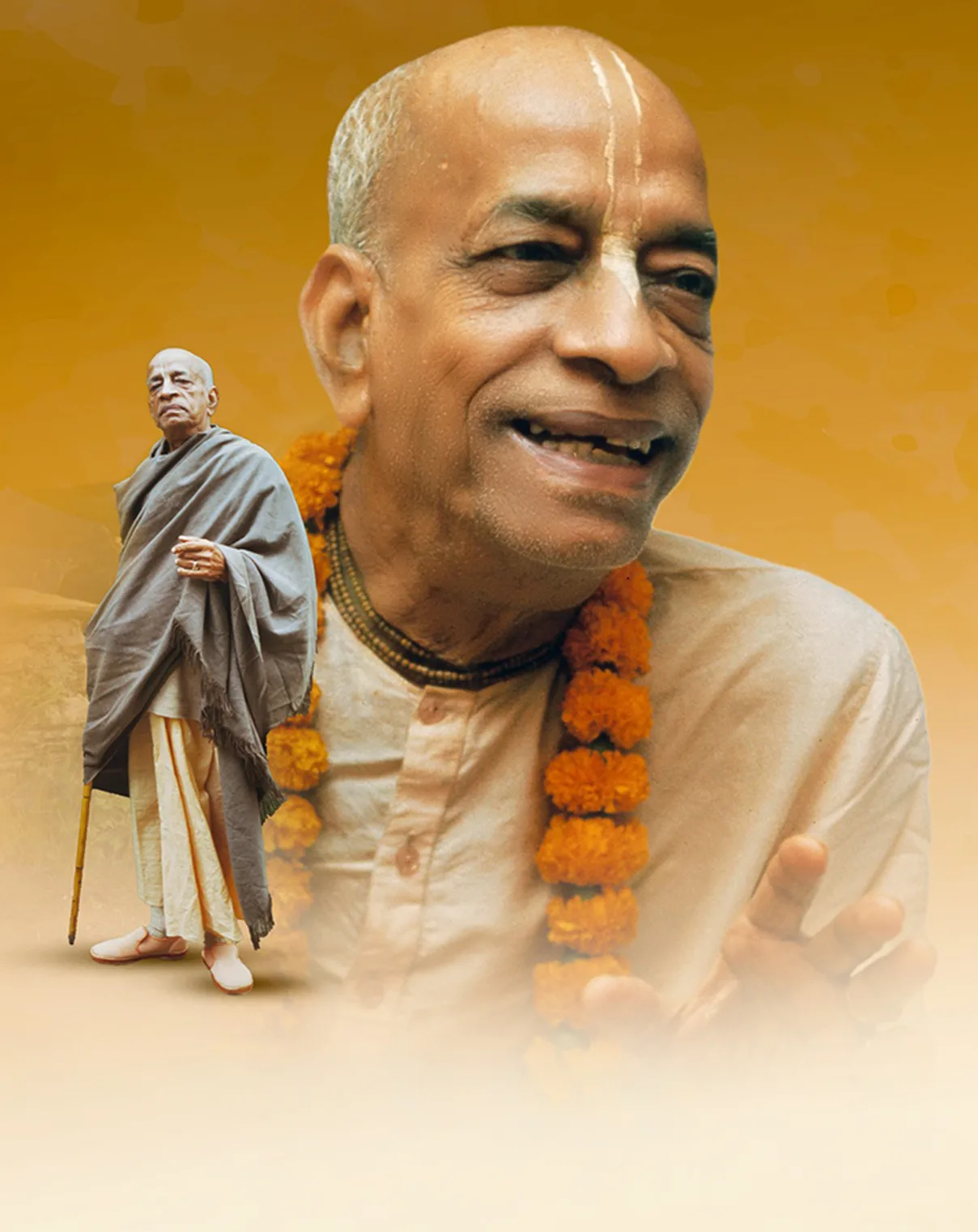 This acharyaSrila PrabhupadaSeptember 1, 1896 – November 14, 1977

His writings
Books
Stories of his life
Pastimes
 Pastime
Srila Prabhupada's Journey to America
At the age of 69, Srila Prabhupada traveled from India to America to fulfill the instruction of his spiritual master.
- Pastime
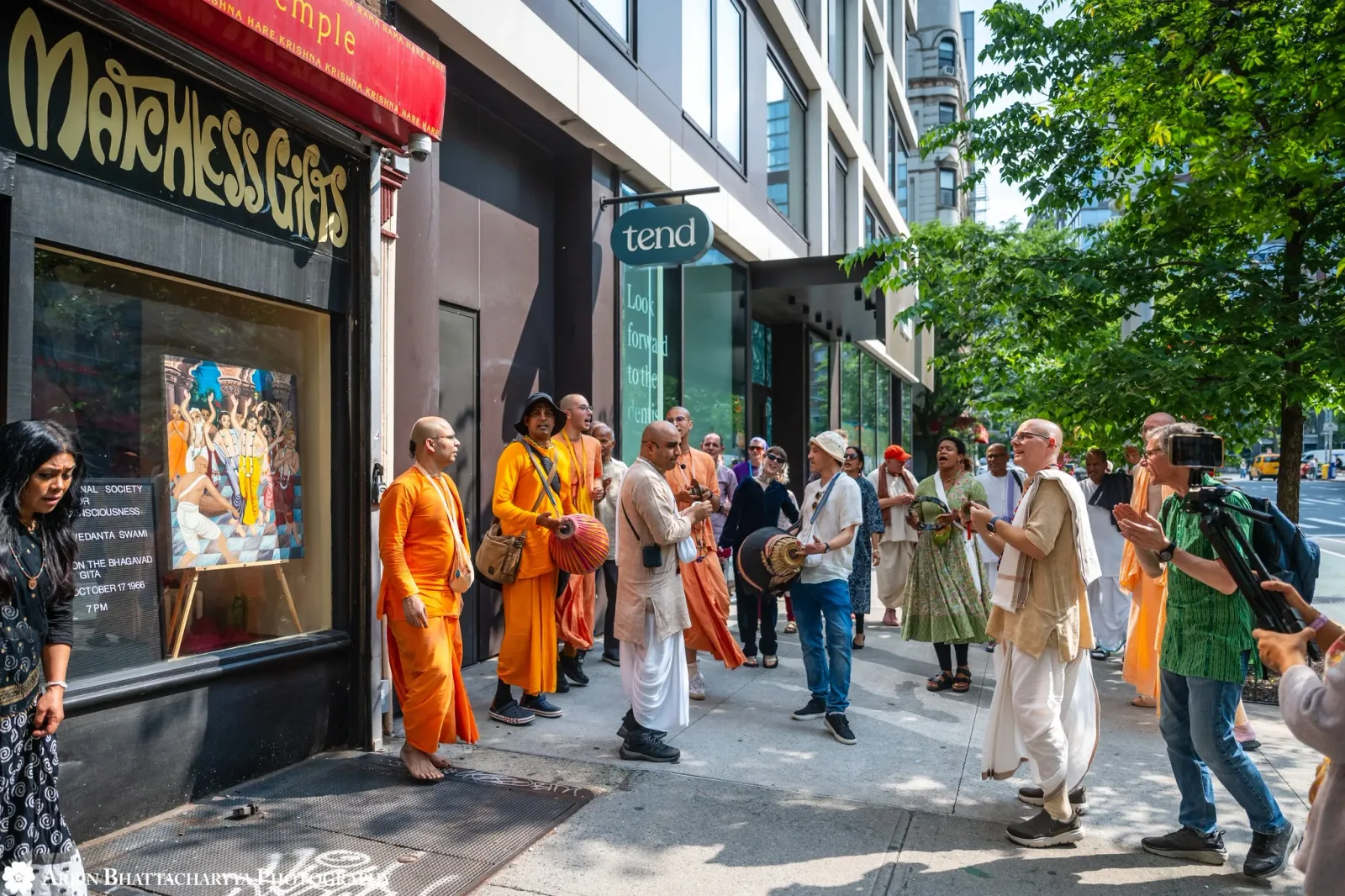
Chanting in Tompkins Square Park
Srila Prabhupada introduced the chanting of the Hare Krishna maha-mantra to the public in New York City.


The acharyas
More acharyas
Continue along the disciplic succession.
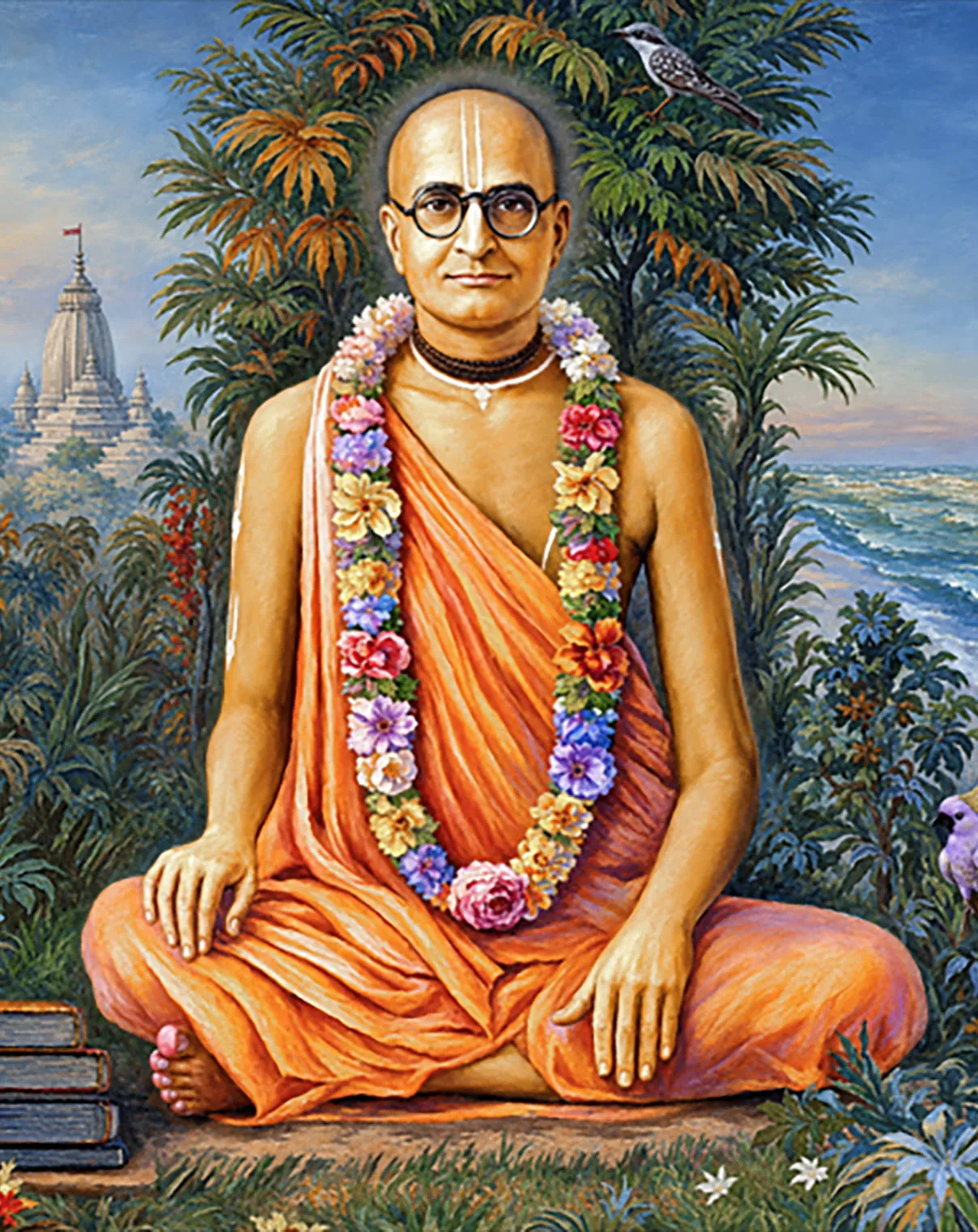
Srila Bhaktisiddhanta Sarasvati Thakura
Founder of the Gaudiya Math and spiritual master of Srila Prabhupada
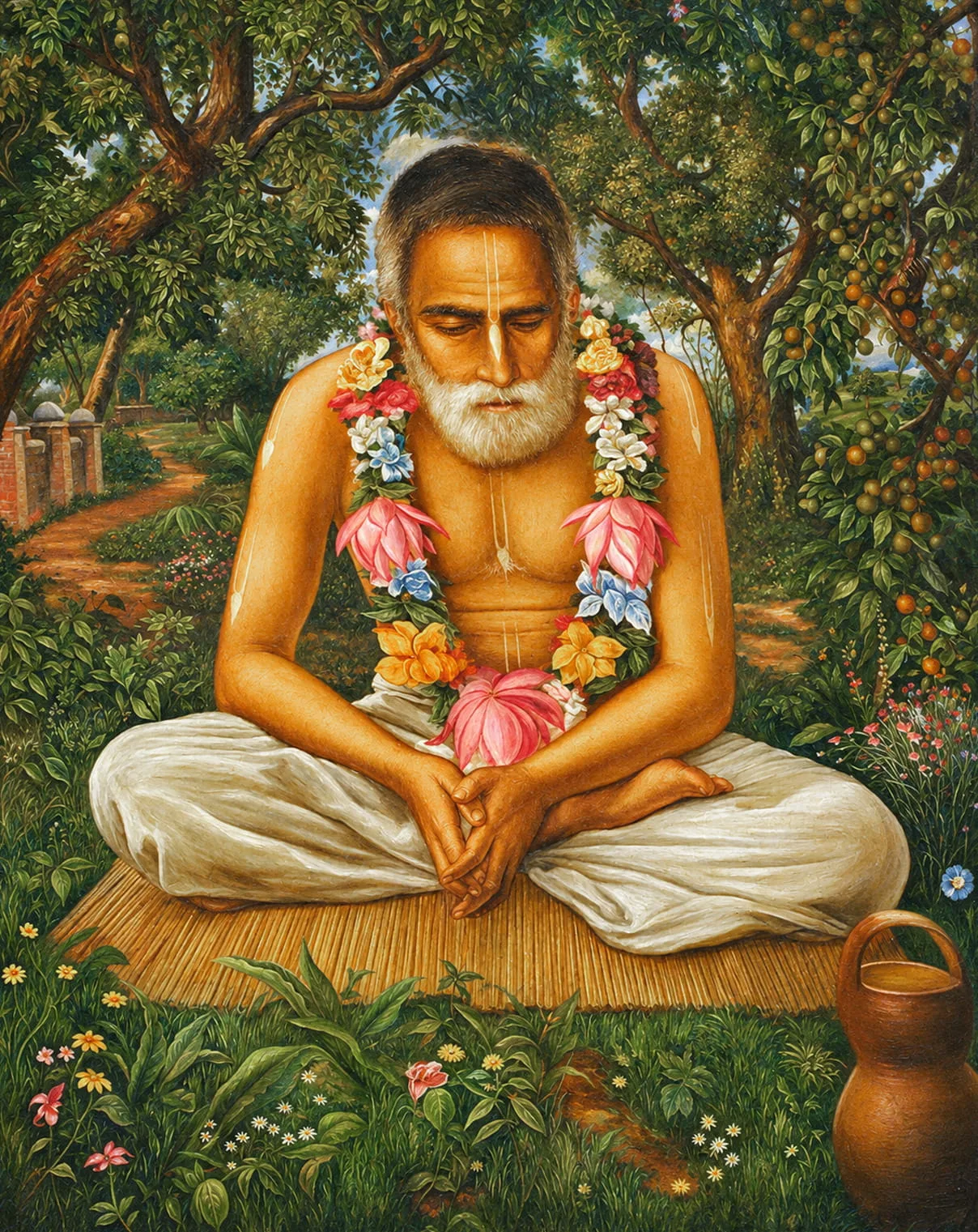
Srila Gaura Kishora Dasa Babaji Maharaja
Paramahamsa babaji and spiritual master of Bhaktisiddhanta Sarasvati Thakura
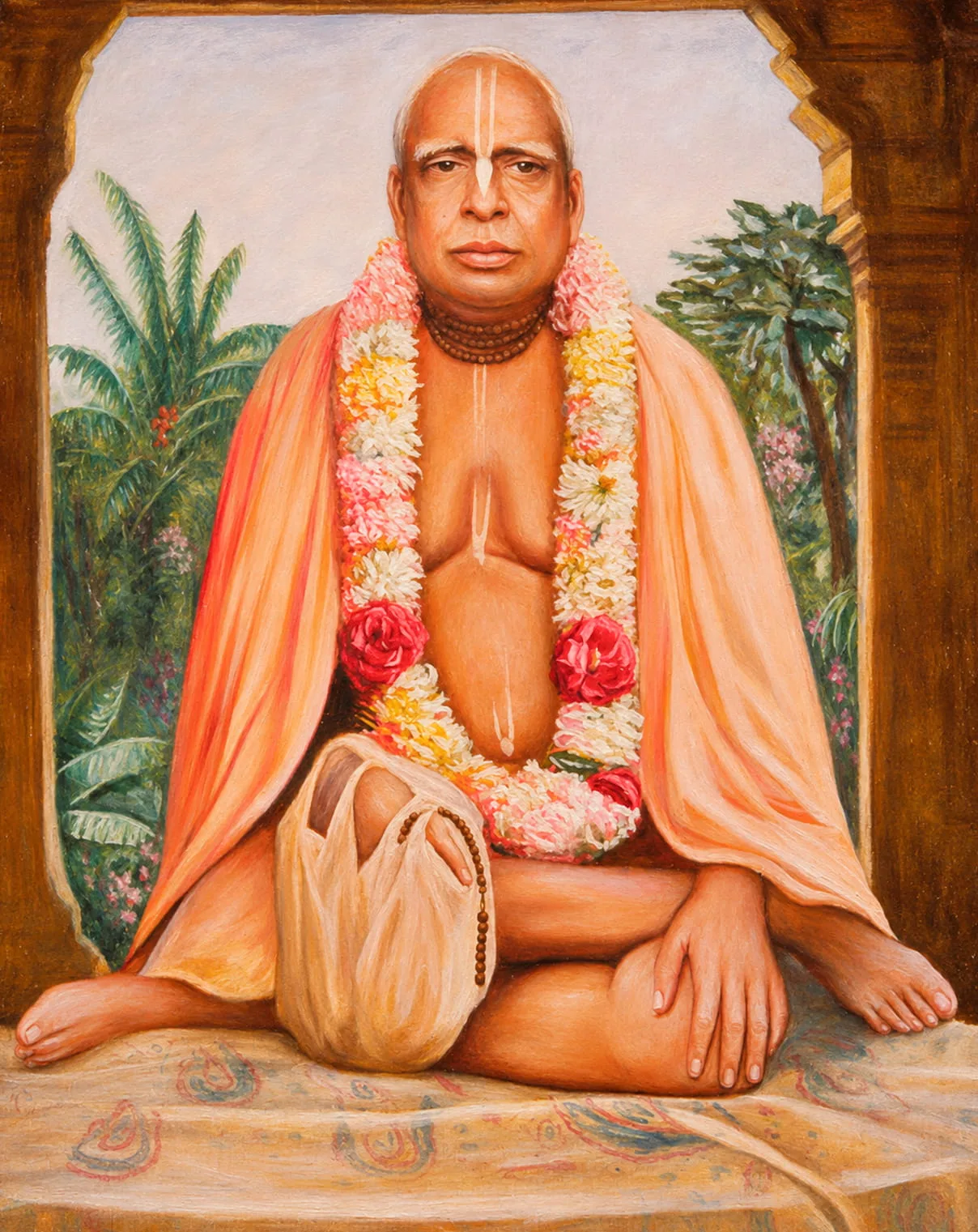
Srila Bhaktivinoda Thakura
The Seventh Goswami, pioneer of the modern Krishna consciousness movement
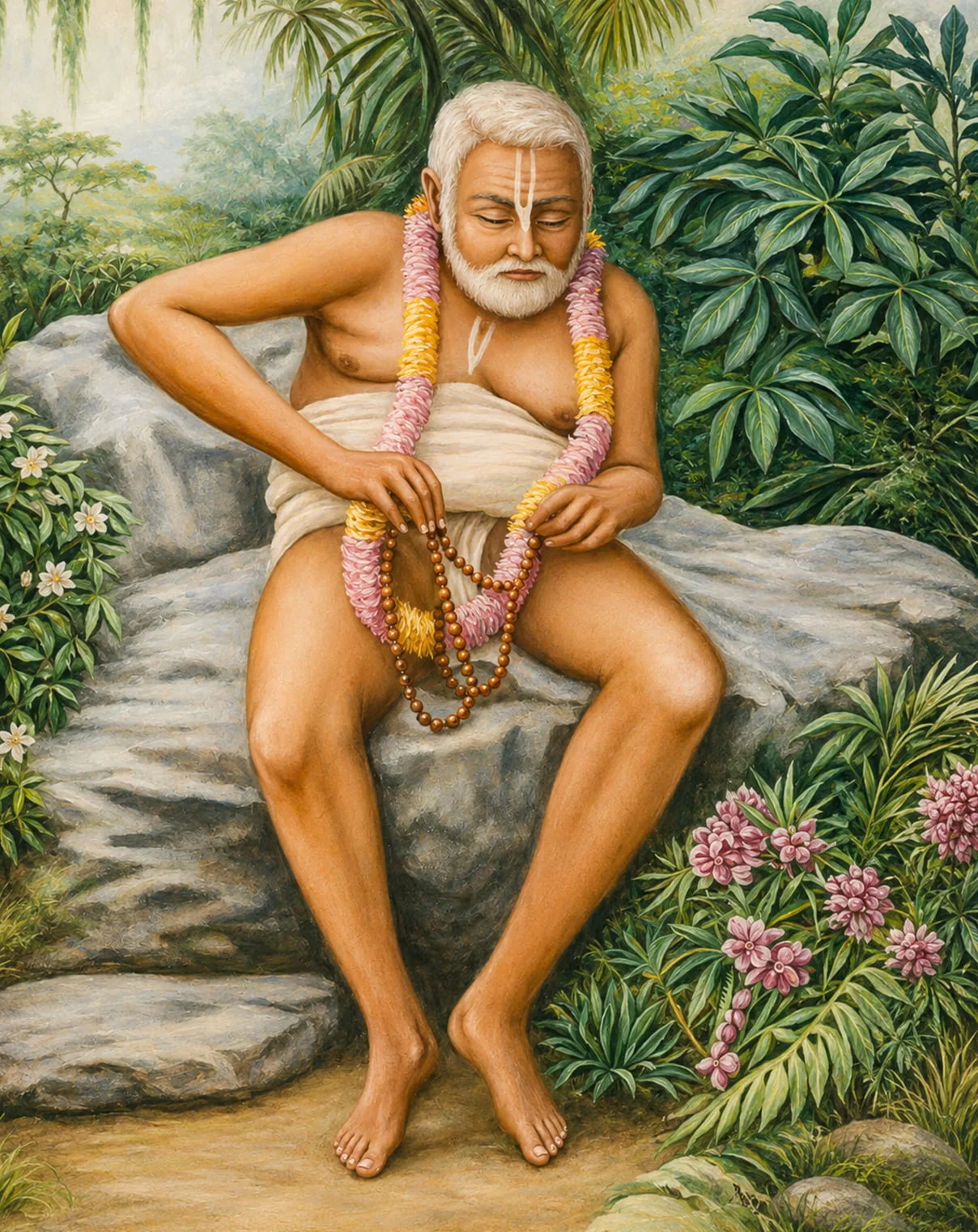
Srila Jagannatha Dasa Babaji Maharaja
Vaishnava Sarvabhauma, who confirmed Lord Chaitanya's birthplace